

Spokane and Spokane Valley CRE: The Productive Paradox Holds
Eastern Washington CRE Market Intelligence | Coverage Period: Q2 2026 (data current through June 2026). I have AI put together a briefing for me so I can stay reasonably up-to-date with the overall market.
Spokane enters the middle of 2026 in a condition that local brokers have taken to describing as a productive paradox: the supply-and-demand fundamentals across the metro are healthier than most markets in the country, yet the transaction market has nearly ground to a halt. For lenders, investors, and owner-users active in Spokane and Spokane Valley, that gap between strong fundamentals and frozen deal flow is the defining feature of the market, and it has direct consequences for how due diligence should be timed and scoped on the transactions that do clear.
The Capital Backdrop: Higher for Longer, Confirmed
The cost-of-capital question that has driven Spokane pricing for two years moved decisively in the second quarter. On June 17, 2026, the Federal Reserve held the federal funds rate at 3.50 to 3.75 percent for a fourth consecutive meeting, the first under new Chair Kevin Warsh, on a unanimous 12-0 vote (Source: Federal Reserve FOMC statement, June 17, 2026). More important for underwriting than the hold itself was the shift in tone: the Committee removed prior easing-bias language and its updated projections moved the median year-end rate to roughly 3.8 percent, with futures markets now pricing the possibility of a 25-basis-point hike as early as October 2026, largely on energy-driven inflation tied to conflict in the Middle East (Source: Federal Reserve Summary of Economic Projections and CNBC, June 2026). This reverses the early-2026 expectation of rate cuts and removes a tailwind that some Spokane buyers had been underwriting into their pro formas.
On the ground, that translates into commercial loan rates in the 6.5 to 7.5 percent range, loan-to-value ratios restricted to roughly 60 to 65 percent, and a 10-year Treasury hovering near 4.35 to 4.40 percent at quarter end (Source: CoStar data via ACTIV8 Real Estate, Q1 2026). The practical effect is a pricing standoff. Buyers underwriting to today's debt costs need capitalization rates near 8 percent or higher to achieve positive leverage, while many sellers are not yet willing to transact at those levels. Cap rates are not compressing, valuations are not rebounding, and refinancing risk remains elevated for owners with loans maturing into this environment.
Industrial: Tight Fundamentals, Frozen Transactions
Spokane's roughly 56.4-million-square-foot industrial market posted a vacancy rate of 5.8 percent in the first quarter of 2026, well below the national industrial availability rate of 9.6 percent, with average asking rents around $9.40 per square foot and trailing-year net absorption of about 448,000 square feet against only 92,000 square feet of new deliveries (Source: CoStar via ACTIV8 Real Estate, Q1 2026, as of April 6, 2026). By every measure of supply and demand, this is a healthy market. Yet first-quarter sales volume was only about $102.3 million at an implied cap rate near 8.2 percent, reflecting the same standoff visible across the metro.
The headline vacancy figure also masks a sharp submarket divergence that matters for site-level due diligence. The North Metro corridors are at or near functional full occupancy, with vacancy reported at 1.4 percent in SW North Metro, 2.0 percent in SE North Metro, and 2.1 percent in NE North Metro (Source: CoStar via ACTIV8 Real Estate, Q1 2026). The elevated vacancy is concentrated in the West Plains, at 19.3 percent and roughly 1.72 million square feet of vacant space, a direct legacy of aggressive logistics construction in 2022 through 2024 that outpaced demand. For an investor evaluating a West Plains big-box asset, the condition questions are specific: membrane condition and remaining useful life on large flat roofs, drainage adequacy, and the re-tenanting capital required to make long-idle space competitive. A building that has sat partially vacant carries deferred-maintenance risk that a vacancy rate alone will not reveal.
Office: A Valuation Reset Downtown
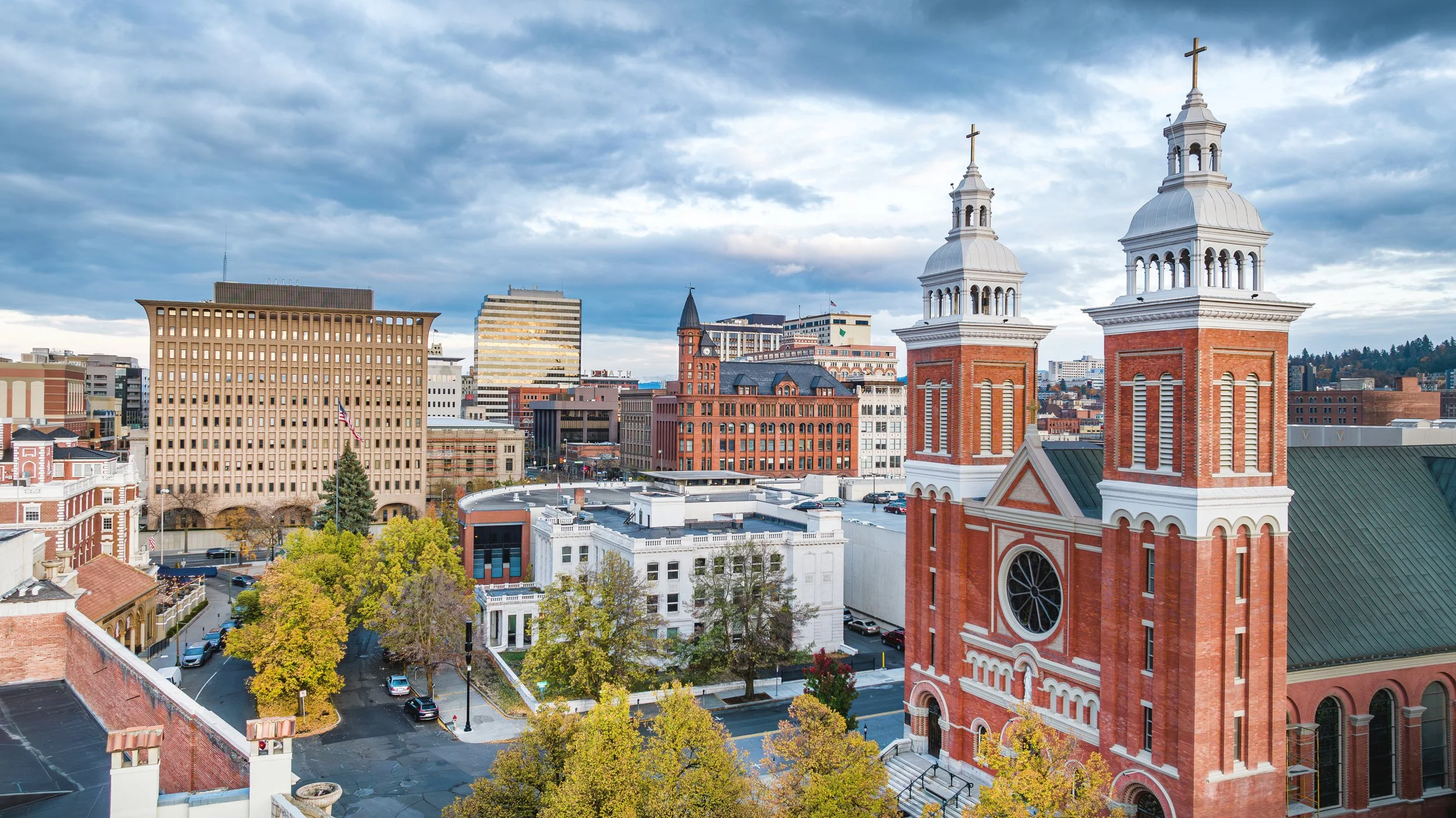
Downtown Spokane's office sector remains the metro's weakest. Vacancy was reported in the high-20s to low-30s percent range as of late 2025, with one widely cited figure near 28 percent and a local brokerage principal citing 32 percent (Source: The Spokesman-Review via TenantBase and Spokane Journal of Business, December 2025). The consequence is a valuation reset that has stripped assessed value from landmark assets, and the city's response has tilted toward residential-led revitalization, including continued expansion at Kendall Yards and discussion of downtown housing that could eventually support additional ground-floor retail (Source: Downtown Spokane housing and economic reporting via TenantBase, early 2026). For owners and lenders, the underwriting implication is that some downtown office product will not pencil as office at current rents, making conversion feasibility a live question. That, in turn, raises the bar on pre-acquisition diligence: structural capacity, mechanical and electrical system condition, and a realistic cost-to-cure estimate are the difference between a viable adaptive-reuse play and a stranded asset.
Retail and Multifamily: Selective Strength
Retail conditions split along the same urban-suburban line. Spokane Valley retail vacancy has improved markedly over the past decade and a half to roughly 4 to 5 percent, a level brokers consider healthy, while downtown retail continues to struggle because it leans heavily on daytime office occupancy that has not recovered (Source: Kiemle Hagood via Spokane Journal of Business, mid-2025). The contrast reinforces a recurring theme for Calibre clients: in Spokane, the submarket and the rent roll matter more than the metro-level average.
Multifamily, relevant here only for its effect on lenders and investors, is stabilizing. Countywide apartment vacancy peaked at 9.2 percent in the third quarter of 2024 and had improved to about 7.47 percent by the second quarter of 2026 as construction slowed sharply, from roughly 2,053 units delivered in 2024 to about 784 in 2025, below the historical average of approximately 1,200 units per year (Source: SVN Cornerstone, June 2026). Some owners reported renewed rent increases in select submarkets as of June 2026, though North Spokane and Spokane Valley continue to carry higher vacancy. Spokane County's population stood at about 562,325 with year-over-year growth near 0.57 percent in 2026 (Source: SVN Cornerstone, June 2026).
What This Means for Calibre's Clients
Spokane rewards precision right now. With deal flow thin and underwriting conservative, the transactions that do close are scrutinized closely, and an accurate property-condition assessment with a defensible cost-to-cure estimate carries real weight in the lender's decision. The clearest condition risks track the market's weak points: long-idle West Plains industrial space where roof, envelope, and re-tenanting capital are the open questions; downtown office assets where conversion feasibility depends on structural and systems condition; and any asset with a maturing loan, where refinance risk makes the timing of diligence as important as its scope. Engaging an ASTM E2018 Property Condition Assessment early, and sizing the inspection scope to the specific asset class and submarket, is the most direct way for Spokane buyers and lenders to keep a pricing standoff from becoming a closing-stage surprise.
Coverage Note and Sources
This article analyzes confirmed, directional trends through a due-diligence and underwriting lens and is not investment advice. Spokane commercial data is reported predominantly on a quarterly basis; where current-quarter figures were unavailable, the most recently reported period is used and labeled, and figures are not estimated. Primary sources: Federal Reserve FOMC statement and Summary of Economic Projections (June 17, 2026); CoStar via ACTIV8 Real Estate, Spokane Industrial Market Report Q1 2026; SVN Cornerstone Spokane County multifamily update (June 2026); Spokane Journal of Business and The Spokesman-Review (2025-2026); and Kiemle Hagood commentary (mid-2025). National figures are referenced only where Spokane impact is explained.