

CRE Electrical Systems — 480Y/277 Volts — Size Matters
How High-Voltage Distribution and Step-Down Transformers Shape Capacity, Flexibility, and Due Diligence in Flex and Industrial Buildings
A commercial building's electrical service is the first honest statement on the loads and capacities of the system — before the panels, switches, and cabinets. Square footage describes the space; the service describes the work that space can support. For a flex warehouse or a light-to-heavy industrial building, that distinction decides which tenants the asset can court and which it has to turn away.
Most buildings in the small-commercial world arrive at a single, familiar service: 208Y/120 volts, three-phase, four-wire, sized for lighting, receptacles, and modest equipment. It is the residential pattern scaled up, and it is what an inspector trained on houses expects to find. A building fed at 480Y/277 volts, with transformers stepping the power down to 208/120 at the point of use, looks different enough that it can read — to the wrong eye — as a complication. It is the opposite. It is the signature of a building engineered to do real work.
A 480-Volt Service Is Built Around the Load, Not the Lighting
In a 480Y/277-volt system, the utility delivers 480 volts between phases and 277 volts from any phase to neutral. The heavy three-phase loads in the building — rooftop HVAC, compressors, dock equipment, shop machinery — connect to the 480-volt service directly, because that is the voltage they are built to run on.
Everything that needs ordinary 120- and 208-volt power gets there through step-down transformers. A typical unit is a dry-type general-purpose transformer with a 480-volt delta primary and a 208Y/120-volt secondary, and 75 kVA is a common size for a tenant suite. In a multi-tenant flex building, these transformers are often distributed — one near each suite, each feeding a local 208/120 panel for that tenant's lighting, receptacles, and small equipment.
The result is two voltage worlds in one building: 480 volts for the muscle, 208/120 for everything a person plugs in.
Higher Voltage Buys Capacity, Flexibility, and Lower Losses
Power is the product of voltage and current. Deliver it at a higher voltage and the same work requires proportionally less current — a given load draws less than half the current at 480 volts that it would at 208. Lower current is not an abstraction. It means smaller conductors, lower resistive losses across the long runs a warehouse demands, and less voltage drop at the far end of the building. For an owner, that shows up as lower distribution cost and steadier power at the point of use.
It also means headroom. A 480-volt service sized for industrial work can absorb a power-hungry tenant — a fabricator, a commercial kitchen, a cold-storage operator, a charging depot — without a utility service upgrade. The building that already carries 480 volts to its suites can add a step-down transformer where it is needed and serve the load. The building stuck at 208 volts often cannot, and a service upsize is a long, expensive, utility-gated project.
For a broker, this is a leasing argument. For an investor weighing a flex or industrial asset, it is a question of which half of the market the building can lease to. The power supply is, in plain terms, a capability statement — and high-voltage service reads as an asset to anyone who knows how to read it.
The Same Architecture Carries Specific Things to Verify
Capability is the upside. The same configuration also concentrates a handful of conditions that a competent commercial inspection is expected to read, and that an inspector working from a residential background will not know to look for. None of them are exotic. All of them carry cost.
Transformer ventilation clearance. A dry-type transformer is a heat engine wrapped in a steel cabinet, and its nameplate specifies a minimum clearance — commonly 6 inches — between its ventilation openings and any adjacent surface. In a leased suite, that clearance survives exactly until the tenant needs the floor space. Pallets, shelving, and stored inventory pushed against the cabinet choke off the airflow the transformer depends on. The penalty is heat, and heat is what ages insulation and ends a transformer's life early. A transformer that fails takes the suite's power with it.
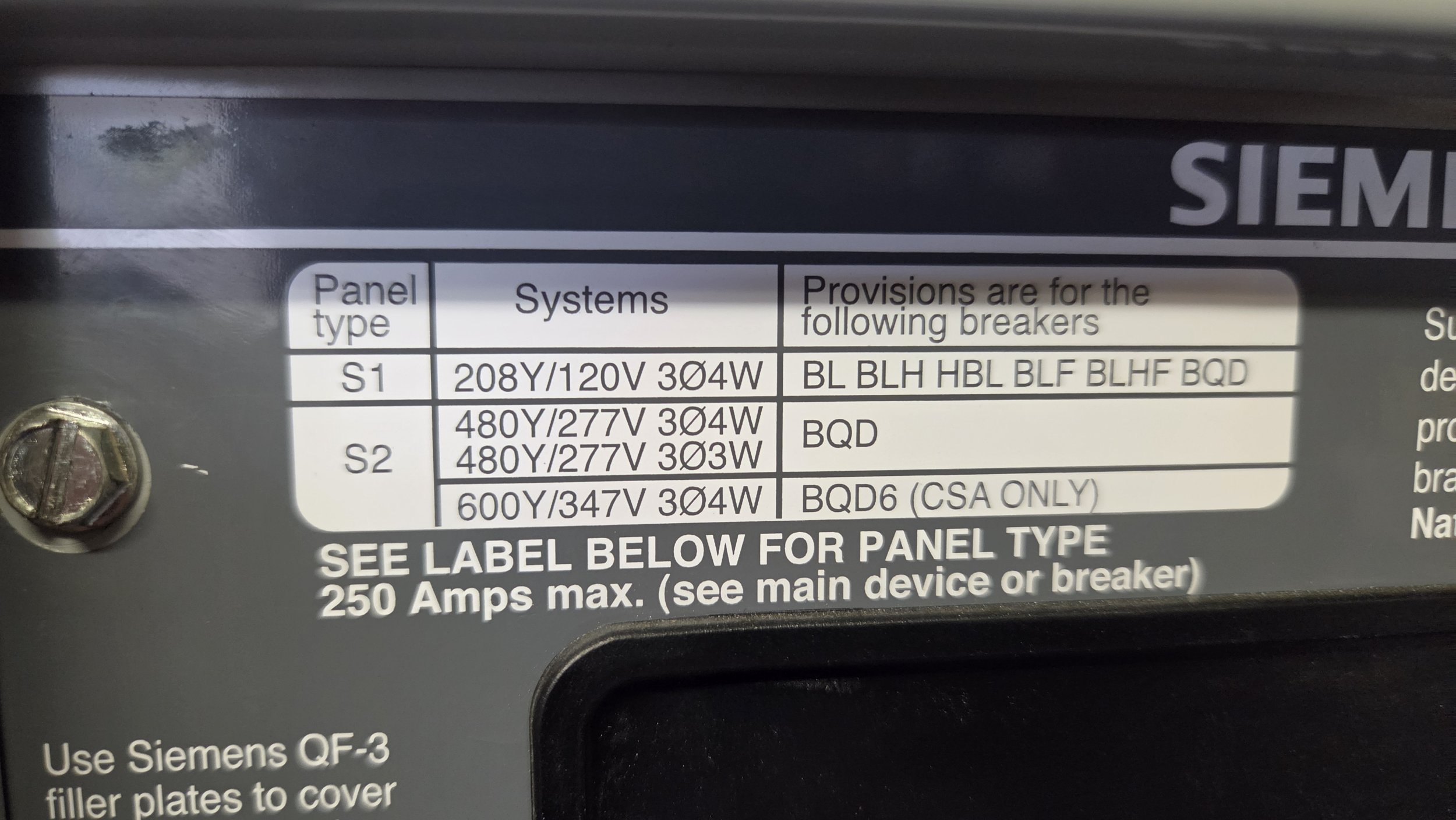
Breaker ratings matched to the system. A panel fed at 480Y/277 volts needs overcurrent devices rated for that system, and the manufacturer's panel label says so plainly — the listed breaker types differ by system voltage. A breaker rated only for 240 volts has no business in a 480/277 panel, and one pressed into service above its rating may not interrupt a fault safely. Reading the panel label and confirming the installed breakers match the system is a basic act of competent inspection. It is also the kind of mismatch a residential-trained eye slides right past.
Available fault current against panel rating. Every transformer carries an impedance figure on its nameplate, and that figure, with the transformer's size, sets the maximum fault current its secondary can deliver. A 75 kVA transformer at around 6 percent impedance can push on the order of 3,300 amps into a fault at its secondary terminals. The panel and breakers downstream have to carry an interrupting rating at least that high. When they don't, the safety margin the system is supposed to provide is not actually there — a deficiency that stays invisible without someone who knows the calculation.
Grounding of each separately derived system. This is the one the average inspector never sees. Each step-down transformer creates what the National Electrical Code calls a separately derived system, and Article 250 requires each one to be bonded and tied to a grounding electrode on its own. A building with four transformers has four separately derived systems, each needing its grounding done correctly. Get it wrong and faults do not clear the way they are supposed to. Four transformers means four chances to find it done wrong — and four reasons to look.
What Due Diligence Should Actually Cover
A baseline commercial inspection under ASTM E2018 or the CCPIA Commercial Standards of Practice describes the electrical system and identifies the visible deficiencies in it — the blocked transformer, the mismatched breaker, the grounding done wrong. That is the floor, and it is worth insisting on.
The question a buyer or broker usually cares about — is there capacity here for the tenant I have in mind? — sits one step beyond that floor. Reading present load and remaining headroom is something a competent inspector can speak to at the level of the system; pinning it to a number that a lease or a build-out can rely on is a load study, and that is the boundary between inspection and engineering. The right move is for the inspection to define the parameters and, when the stakes warrant it, hand off to the appropriate specialist for the calculation. A buyer who knows where that line falls is the one who does not get surprised after closing.
Read the Power, Not Just the Panel Count
A building's service tells you what it can do, but only if someone reads it correctly. The voltage on the meter is a capability; the condition of the transformers, panels, and grounding is whether that capability is real and safe. One is a selling point. The other is what due diligence is for.
At Calibre, we know when to defer to the engineers — and we read electrical systems the way a building's future tenants will test them. As the region's only commercial-focused inspection firm, we cover Idaho, Eastern Oregon, Eastern Washington, and Western Montana. Contact us to discuss your property before its power supply becomes a question you cannot answer.