
The Warehouse That Was Built Inside-Out
What reversed metal siding means for a pure-storage commercial building — and why the envelope is the whole asset
A pure-storage warehouse is about the most honest building I inspect. No tenants to please, no commercial kitchen, no offices to condition — just a slab, a steel frame, a roof, and four walls with a single job: keep the weather off whatever is stacked inside. Sometimes there’s a little heat, but not much. When a building’s whole purpose comes down to one task, there is nowhere for a problem to hide.
On a recent inspection of a 28,000-square-foot metal storage building on the Palouse, in Eastern Washington, the walls themselves were the finding. The wall panels had been installed inside-out.
One Job, Done Backwards
Metal wall panels are not symmetrical, and they are not meant to be flipped. The exterior face carries the finish — a factory-applied coating engineered to shed water, hold up under UV, and back a manufacturer’s warranty that can run up to 40 years. The interior face is bare or lightly primed, built to live indoors where weather never touches it. On this building, the process was reversed — and not in one spot. I walked all four elevations looking for a patch or a single mismatched panel, and found the interior face turned out on every one.
One error, and the failures stack. The exposed back face was already chalking, with rust starting to bleed through — coating breakdown years before it should show. Where the panels lap, the seams ran the wrong direction, positioned to drive water behind the panel instead of shedding it down the face. And the finish warranty that should have protected this owner for decades was void the moment the panels went up backwards. No manufacturer honors a coating installed facing the wrong way.
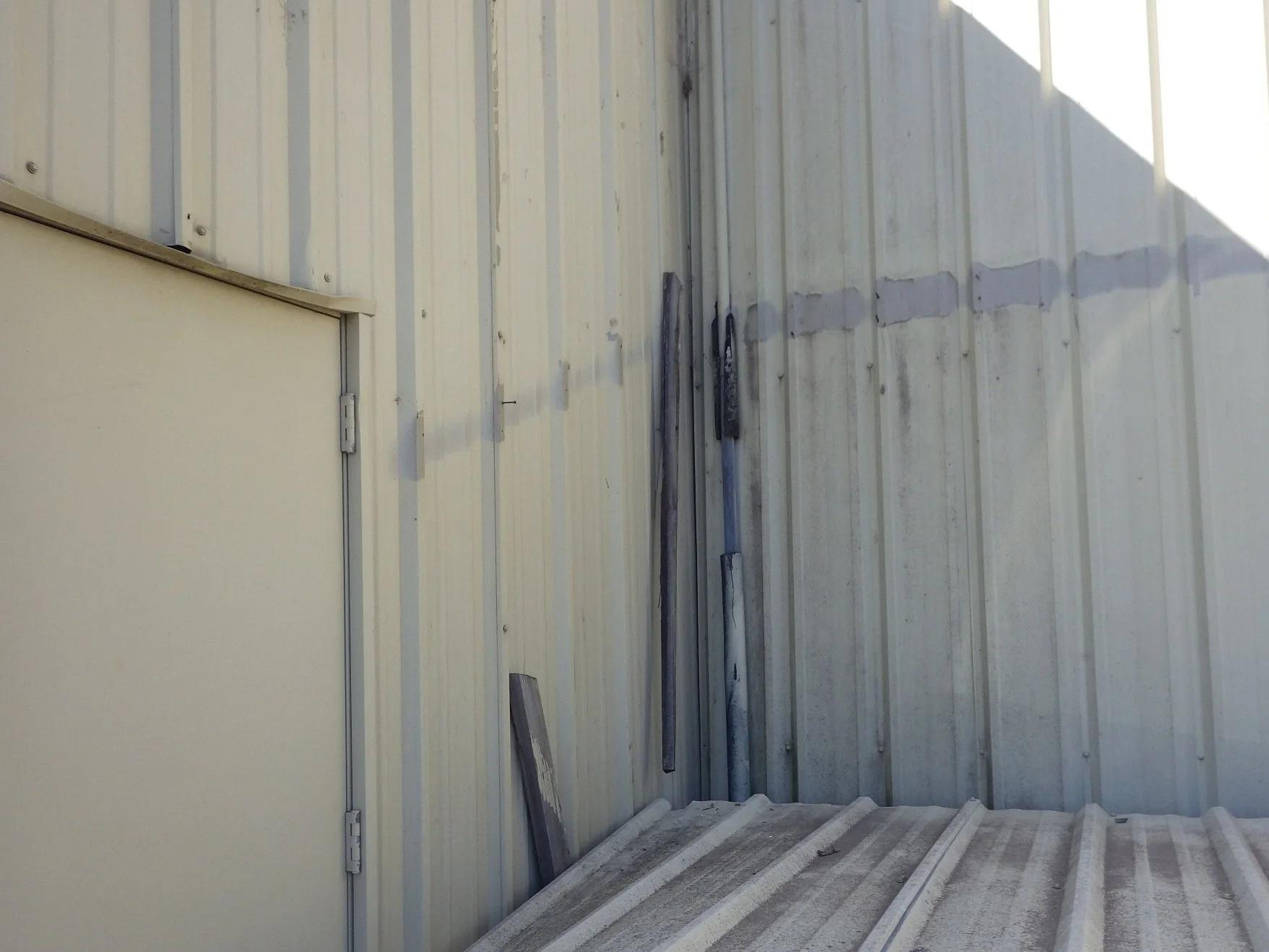
The orientation does more than void a warranty — it works against the building’s thermal envelope and its ability to drain. A wall panel’s profile is engineered to do two jobs in one direction: bed flat against the insulation and the girts on the inside, and carry its channels down the exterior face where they shed water. Reverse it, and both jobs fail at once. The panel no longer seats cleanly against the already-limited insulation, opening gaps and air paths that let what little R-value there is bleed straight through. And the profile channels that should run down the weather face are now turned the wrong way — pockets and seams positioned to catch condensation and wind-driven moisture and hold it against the bare metal, with nowhere to drain. A profile built to move water becomes a channel built to trap it.
The Envelope Is the Product
On most buildings, a complaint about siding is a punch-list item — cosmetic, low on the priority stack. On a pure-storage asset, it sits much closer to the center of the deal. The envelope is the product. There is no interior finish, no mechanical system, no tenant improvement carrying the value; the building is worth what its skin can keep out. A wall assembly built to fail at the surface and at the seams is not a cosmetic note on this property. It is a question about whether the asset can do the one thing it was bought to do.
Re-cladding the affected elevations is real money, and the scope grows with every panel that has to come down. But the panels are only the visible half of the problem — they say nothing about the moisture already working toward the framing, the insulation, and the goods stacked behind a wall that was assembled backwards. Caught at inspection, it is a line item in a negotiation. Caught two winters from now, it is corrosion in the structure and a damaged-inventory claim.
This one was caught at inspection. My client had the building under contract when I delivered the report, took it straight into the negotiation, and came away with a significant reduction off the purchase price. The cost of the mistake moved to the side of the table where it belonged.
The lesson sits right on top of the catch. The plainest building on the lot still has to be built right — and the simpler the building, the more weight every single component has to carry. A storage box has one job. When the one thing it is supposed to do is the thing that was done wrong, no amount of clear-span square footage makes up for it.
Calibre Commercial Inspections reads commercial buildings — warehouses included — across Idaho, Eastern Oregon, Eastern Washington, and Western Montana. As the region’s only commercial-focused inspection firm, we look past the square footage to the systems and the envelope that actually carry the value, so a buyer knows what they are taking on before the keys change hands. Contact us to discuss your property.