

Boise and Treasure Valley CRE: Strong Demand, Tighter Money, Rising Costs
Boise & the Treasure Valley | Reporting window: April 1 – June 30, 2026 | Trend-and-synthesis product. I have AI put together a briefing for me so I can stay reasonably up-to-date with the overall market.
I. Executive Overview
The defining story of the second quarter was a decisive shift in the rate narrative: what began the year as a market pricing in cuts ended Q2 pricing in a possible hike. The Federal Reserve held the federal funds target at 3.50%–3.75% at both its April 28–29 and June 16–17 meetings, but the June Summary of Economic Projections flipped the median dot for year-end 2026 up to roughly 3.8%, implying that at least one increase is now on the table, largely because a Middle East energy shock pushed the Committee's 2026 inflation forecast up to 3.6% headline. That repricing matters more for Idaho commercial real estate than any single local headline, because it resets the discount rate against which every Treasure Valley deal, refinance, and valuation is measured.
Against that tighter macro backdrop, the local demand engine remained exceptionally strong on a structural basis, anchored by Micron's multi-fab Idaho expansion and a fast-growing data-center cluster in Kuna and Boise. Commercial construction costs continued to escalate under a 50% tariff regime on steel, aluminum, and copper, lifting cost-to-cure and replacement-cost math even as new supply reshaped several property types.
Industrial was the quarter's clearest inflection: a market that sat near 1% vacancy in 2022 has absorbed a wave of speculative deliveries and now runs in the 9%–11% range, even as asking rents held above year-ago levels. Office stayed resilient relative to national peers, retail remained landlord-favored and very tight, and hospitality showed early signs of a national RevPAR turn that benefits leisure-heavy Boise. CMBS distress nationally held near multi-year highs but stabilized within the quarter, with office still the structural weak point.
Idaho's economy stayed fundamentally healthy, with unemployment at 3.7% in May — comfortably below the national rate — though federal-government employment continued to contract. The net read for stakeholders: durable long-run demand, a higher-for-longer financing reality, and an escalating-cost environment that places a premium on disciplined, well-documented due diligence.
II. Market & Economic Conditions
Rates & Lending
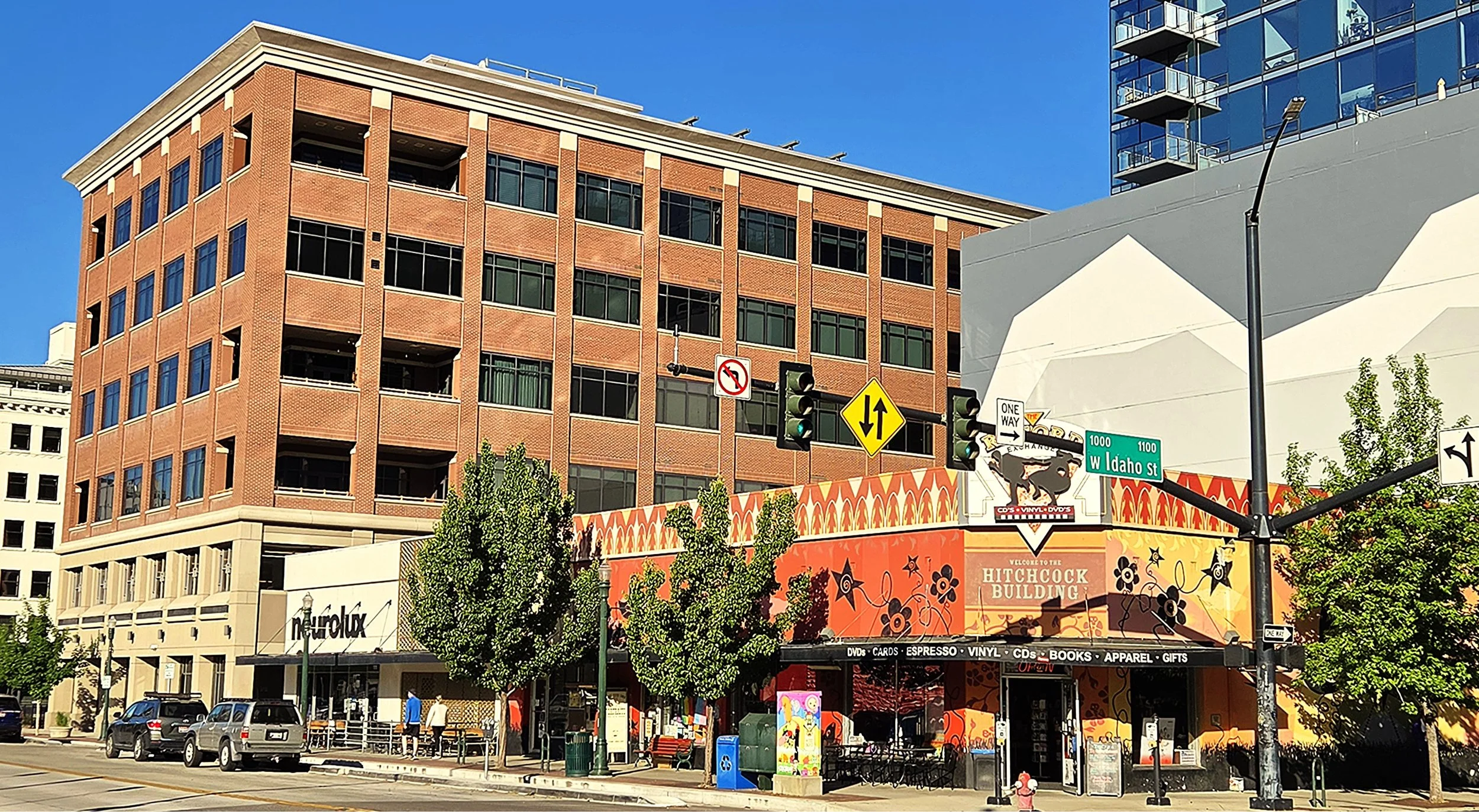
Downtown Boise, A Study of Transition
Both of the quarter's FOMC meetings ended in a hold, but the tone hardened materially between them. The April 28–29 meeting kept the target range at 3.50%–3.75% amid unusually visible internal disagreement, and the June 16–17 meeting — the first chaired by Kevin Warsh — produced a unanimous 12–0 hold paired with a distinctly hawkish projection set. The June dot plot lifted the median year-end 2026 funds rate to about 3.8% from 3.4% in March, with nine of eighteen officials now penciling in at least one hike this year; futures markets responded by pricing a possible 25-basis-point increase as early as October.
The proximate cause was an inflation re-acceleration tied to the Middle East conflict and higher energy prices, which pushed the Committee's 2026 inflation outlook to 3.6% headline and 3.3% core. Treasury yields rose on the June decision, with the 2-year near 4.15% and the 10-year near 4.47%, keeping commercial mortgage rates elevated and refinancing math demanding.
For Idaho borrowers, the practical effect is that the early-2026 hope for cheaper debt has faded. Regional and community banks — still the backbone of Treasure Valley commercial lending — remain selective on construction and value-add credit, leaning on conservative debt-service-coverage and lower leverage. SBA 504 and 7(a) financing continues to be an important channel for owner-users, who now account for a growing share of smaller transactions precisely because they are less rate-sensitive than levered investors.
On the securitized side, the national Trepp CMBS delinquency rate held near 7.55% in May, essentially flat versus the Q1 close, while the special-servicing rate eased to about 10.9%. Office remained the structural stress point at roughly 11.5% delinquent — near its all-time highs — with lodging improving to near 6.0%, multifamily easing to just under 7.0% on large loan cures, and industrial still very low at about 1.3% though rising off a tiny base. The signal for Idaho is that capital is available but cautious, and lenders are underwriting condition and capital needs more rigorously than they did two years ago.
Construction & Development
Construction cost escalation was a defining macro force in Q2 and bears directly on every condition assessment. As of April, tariffs stood at 50% on steel, aluminum, and copper, 25% on their derivatives, 15% on industrial and electrical equipment such as transformers, panelboards, and conduit, and 10% on softwood lumber. Nonresidential construction input prices surged at roughly a 12.6% annualized pace early in the year — the fastest since 2022 — and a widely cited Cushman & Wakefield analysis pegged the tariff-driven increase at about 6% on materials versus a 2024 baseline and roughly 3% on total project cost. A legal wrinkle added uncertainty: courts ruled that emergency-powers tariffs exceeded executive authority, yet the Section 232 metal duties and a time-limited 10% baseline tariff (set to lapse July 24) remained largely in force through the quarter, leaving budgets exposed to policy swings.
In the Treasure Valley, the supply story is bifurcated by property type. Industrial delivered heavily over the past three years and is now digesting that supply, while retail and office construction stayed disciplined, constrained by both cost and a persistent shortage of skilled trades. That labor squeeze is amplified locally by the megaprojects: Micron's fab program and the Kuna data centers are absorbing a large share of the region's licensed electricians and mechanical trades, lengthening schedules and raising bids for ordinary commercial projects. For owners and lenders, the takeaway is that replacement cost is rising, deferred-maintenance items are more expensive to cure than a year ago, and realistic contingency and escalation assumptions belong in every capital plan.
Transaction Volume & Investor Activity
Transaction velocity stayed below the frothy peaks of 2021–2022, held back by the bid-ask gap that wider, higher-for-longer rates inevitably create. Cap rates have reset upward across most property types as borrowing costs stayed elevated, and the June repricing toward a possible hike reinforced that recalibration. Buyer pools tilted toward owner-users and lower-leverage private capital, while institutional and 1031 activity remained selective and quality-focused. Idaho's structural appeal — net in-migration, low taxes, a deep cost advantage versus Seattle, Portland, Salt Lake City, and Denver, and the gravitational pull of Micron — continued to attract out-of-area capital, particularly for industrial land and build-to-suit. The practical implication is that deals are penciling on fundamentals and credit quality rather than on cheap leverage or aggressive exit assumptions, which places a premium on accurate physical-condition and environmental diligence to protect underwriting.
III. Property Type Highlights
Industrial
Industrial was the quarter's most important local rebalancing. A market that posted near-1% vacancy in 2022 has shifted into a clearly supply-driven phase: CBRE reported Treasure Valley industrial vacancy rising to about 9.2% in Q1 2026 (up roughly 90 basis points quarter-over-quarter and 110 basis points year-over-year), while Colliers, using a broader footprint, put it near 10.6%. Over the Q1 2023 to Q1 2026 window, roughly 7.5 million square feet delivered against about 4.1 million square feet of net absorption, lifting vacancy by nearly seven percentage points. Importantly, this is supply outpacing demand, not demand collapsing — net absorption stayed positive in most quarters, and asking rents were still up about 2.7% year-over-year even after a modest quarter-over-quarter dip. The long-run demand case remains intact, underpinned by Micron, the data-center cluster, I-84 logistics access, and continued in-migration. For diligence, the elevated-vacancy phase means more recently delivered shells, more first-generation tenant improvements, and more owner-user purchases of as-is space — all of which reward careful roof, structural, and building-systems assessment.
Office
Boise office continued to outperform national peers, which remain weighed down by record CMBS office distress above 11%. Cushman & Wakefield placed Boise office vacancy near 11.5% at the most recent reading — elevated versus the metro's own history (up roughly 200 basis points year-over-year) but well below the high-teens national average. Local leasing has been carried by organic growth among Idaho businesses rather than large corporate relocations, and asking rents have held, with overall full-service rates around the low-$20s per square foot and Class A and the South Meridian/Eagle submarkets commanding a premium near $28. A continued flight to quality is widening the gap between modern, amenitized space and older, mechanically dated stock. For investors and lenders, older Class B and C office carries the most condition and capital-reserve risk, making HVAC life expectancy, envelope performance, and ADA accessibility central diligence questions.
Retail
Retail remained the Treasure Valley's tightest and most landlord-favored sector. Ada County retail vacancy ran in the low-4% range, Meridian sat near 1.2%, and the Eagle Road corridor dipped under 1%, with limited new supply and steady backfilling of big-box space keeping fundamentals firm. Class A asking rents pushed to record highs in the mid-$40s per square foot for new construction, a level that increasingly steers value-seeking tenants into upgraded Class B space. The quarter's signature event was the May 5 groundbreaking of The District at Ten Mile in Meridian, a 220-acre mixed-use development anchored by Meridian's first Target and a roster of national restaurant and retail tenants, alongside continued expansion at The Village at Meridian. New retail construction at these rents and these material costs raises the stakes on build-quality verification and on confirming ADA-compliant site and tenant build-outs from day one.
Hospitality
Hospitality showed early signs of a national turn that favors Boise's leisure-heavy profile. After U.S. RevPAR slipped about 0.2% in 2025 — its first non-recessionary decline since 2020 — it reversed course in early 2026, rising roughly 4.3% in February and 5.9% in March year-over-year, and full-year forecasts were upgraded toward the 2%–3% range. Geopolitical tension is tempering new hotel development while nudging would-be international travelers toward domestic destinations, a tailwind for markets like Boise that compete with international leisure alternatives.
Boise's downtown room base (now around 1,600 rooms, with a new downtown Marriott in the pipeline) and steady business demand from Micron and data-center construction support occupancy, though elevated construction and insurance costs continue to pressure new-build feasibility. Aging limited-service and extended-stay assets warrant close attention to life-safety systems, roof and envelope condition, and PIP-driven capital needs.
Mixed-Use & Multifamily
Mixed-use momentum is concentrated in Meridian and along the Treasure Valley's primary corridors, where projects such as The District at Ten Mile blend retail, office, and residential in a single entitlement — a structure that adds complexity to building-systems segregation, fire/life-safety zoning, and accessibility paths that diligence must untangle.
On the multifamily side, relevant chiefly as collateral for commercial lenders and investors, Boise vacancy stabilized near 5.0% at the most recent reading, recovering from a late-2023 peak around 5.6% as a heavy delivery pipeline was absorbed. National multifamily CMBS distress eased within the quarter on large loan cures but remains historically elevated, underscoring that even in a structurally growing market, newer lease-up assets and older value-add deals carry distinct condition and capital-planning risk profiles.
IV. Notable Regional & Local News (Treasure Valley Priority)
Boise
Micron's expansion remained the region's dominant economic event. The company's broader U.S. investment vision is expected to create more than 17,000 jobs in Idaho across two leading-edge fabs, with the first Southeast Boise fab on track to complete construction in 2026 and produce first chips in 2027 while a second fab advances through ground preparation.
In the data-center space, ValorC3's facility on Emerald Street is set to open in 2027 and already filed in March to expand by roughly 31,000 square feet before opening, and a large Amazon facility appeared poised for land south of the Boise Airport — both signals of sustained industrial and logistics demand in the core.
Meridian & West Ada
Meridian led the quarter for visible new development. The District at Ten Mile, a 220-acre Ahlquist mixed-use project, broke ground May 5 with Meridian's first Target (about 148,000 square feet) and an associated 230,000-square-foot industrial component, while The Village at Meridian advanced additional retail expansion phases. The West Ada School District also moved ahead with major construction to keep pace with fast-growing neighborhoods. Permit activity through the quarter skewed toward tenant improvements, re-roofs, and signage on existing commercial stock — routine but a reminder that much of the valley's inventory is now entering its first major capital-renewal cycle.
Nampa, Caldwell & Canyon County
Canyon County continued to absorb industrial and retail spillover from Ada County's tighter, pricier submarkets, supported by its land cost advantage and I-84 access. Industrial deliveries in the Nampa and Caldwell corridors contributed to the broader valley supply wave, and jurisdiction nuance matters here: unincorporated Canyon County land between cities falls under county codes and separate fire-district amendments, a frequent source of diligence surprises for out-of-area buyers.
Kuna
Kuna cemented its status as the valley's data-center hub. Meta's roughly $800 million, 960,000-square-foot campus is expected to open in late 2026, and the city has also approved the Gemstone Technology Park, a data-center development reported near $1 billion in scale and engineered for up to 800 megawatts of power demand. These projects bring large infrastructure commitments — and meaningful strain on regional power and water — that will shape entitlement, utility, and environmental diligence in the southern valley for years.
V. Quarter Ahead — What to Watch
The third quarter pivots on three things. First, rates: the July 28–29 FOMC meeting and the late-July inflation prints will determine whether the market's October-hike pricing firms up or fades, and the July 24 expiration of the 10% baseline tariff is a live swing factor for both inflation and construction budgets. Second, supply absorption: watch whether Treasure Valley industrial vacancy stabilizes or drifts higher as additional speculative space delivers, and whether net absorption re-accelerates on the back of Micron- and data-center-linked demand. Third, milestones: Micron's first Boise fab nears construction completion, Meta's Kuna campus approaches its late-2026 opening, and Q2 brokerage reports from CBRE, Colliers, Cushman & Wakefield, and TOK Commercial will confirm the quarter's vacancy, absorption, and rent trajectories. Layered over all of it are wildfire season and the hardening of WUI insurance underwriting, plus any new Idaho code or fire-district amendments that take effect mid-year.
What This Means for Calibre's Clients
For lenders, investors, and brokers underwriting Treasure Valley assets this quarter, three threads converge on diligence. The higher-for-longer rate reality means every deal must pencil on fundamentals and accurate cost-to-cure rather than cheap leverage, which raises the value of a rigorous ASTM E2018 Property Condition Assessment that quantifies immediate repairs and realistic capital reserves. The 50% metals-tariff environment has lifted replacement and repair costs materially, so deferred-maintenance findings carry a larger dollar weight than a year ago — a roof, rooftop unit, or electrical-gear deficiency simply costs more to cure today, and reserve studies should reflect current, not historic, pricing. And with a supply-driven industrial market, record-rent new retail, aging Class B/C office, and a hardening WUI insurance market, condition, environmental, and accessibility risk are not uniform across the portfolio.
Practically, that argues for front-loading diligence: a thorough PCA to size near-term and long-term capital needs against today's escalated costs; a Phase I ESA to clear environmental risk on industrial, infill, and former-agricultural sites — especially in the rapidly converting Kuna and Canyon County corridors; and an ADA study to confirm accessibility compliance on the wave of new retail, mixed-use, and tenant build-outs, as well as on older assets trading hands. In a market where capital is cautious and costs are rising, disciplined, well-documented due diligence is the most reliable way to protect a transaction — which is exactly the standard Calibre brings to every assignment. Due Diligence Done Right.