

It Never Hurts to Look Up
A commercial lumberyard inspection — where retail meets light industrial, and the structural risk lives in the seam.
Lumberyards evoke memories — the smell of pine and cedar, the buzz of forklifts, summer home repair projects. The customers enter through the retail space, filled with possibilities and get sent to a foreign land to load their materials. Truck drivers deliver to the rear of the yard, never seeing the glitz. Yard workers manage the interface between the two.
With lumberyards, perspectives change constantly.
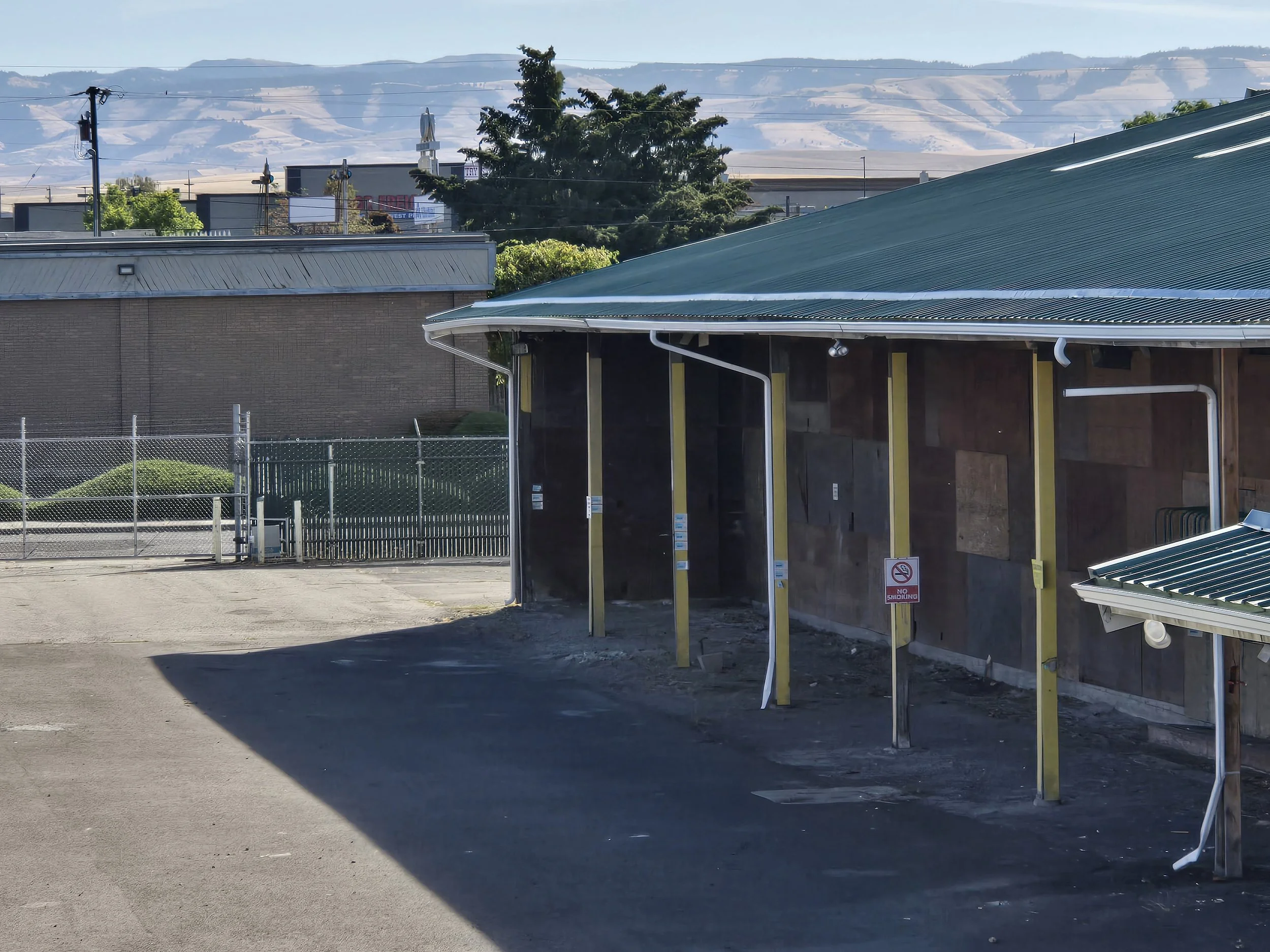
A sagging roof, noted from the warehouse roof.
For the commercial inspector, a lumberyard is a complex interlocking series of buildings and purposes.
Take a lumber shed, an old one, open to wind. Workers are in and out of it all day, moving materials. Customers pull up to get loaded. Do they look up?
The lumber shed used wood columns bearing to concrete footings — straightforward construction, the kind that does its job for decades if nothing hits it. It was a lumberyard — of course something had hit this one.
The bases of two columns were damaged, the corner support for the roof assembly sat roughly two inches off its footing, and the columns were no longer plumb.
That open fourth wall is not just a loading convenience. It creates a structural challenge. A large opening into an enclosed space catches wind like a spinnaker — except the bag being filled is the shed itself, and the roof is what gets lifted. Air drives in through the opening and pressurizes the interior, pushing up and out on the roof rather than sliding over it. The uplift runs higher than it would on a closed building — and it runs highest at the corners and edges.
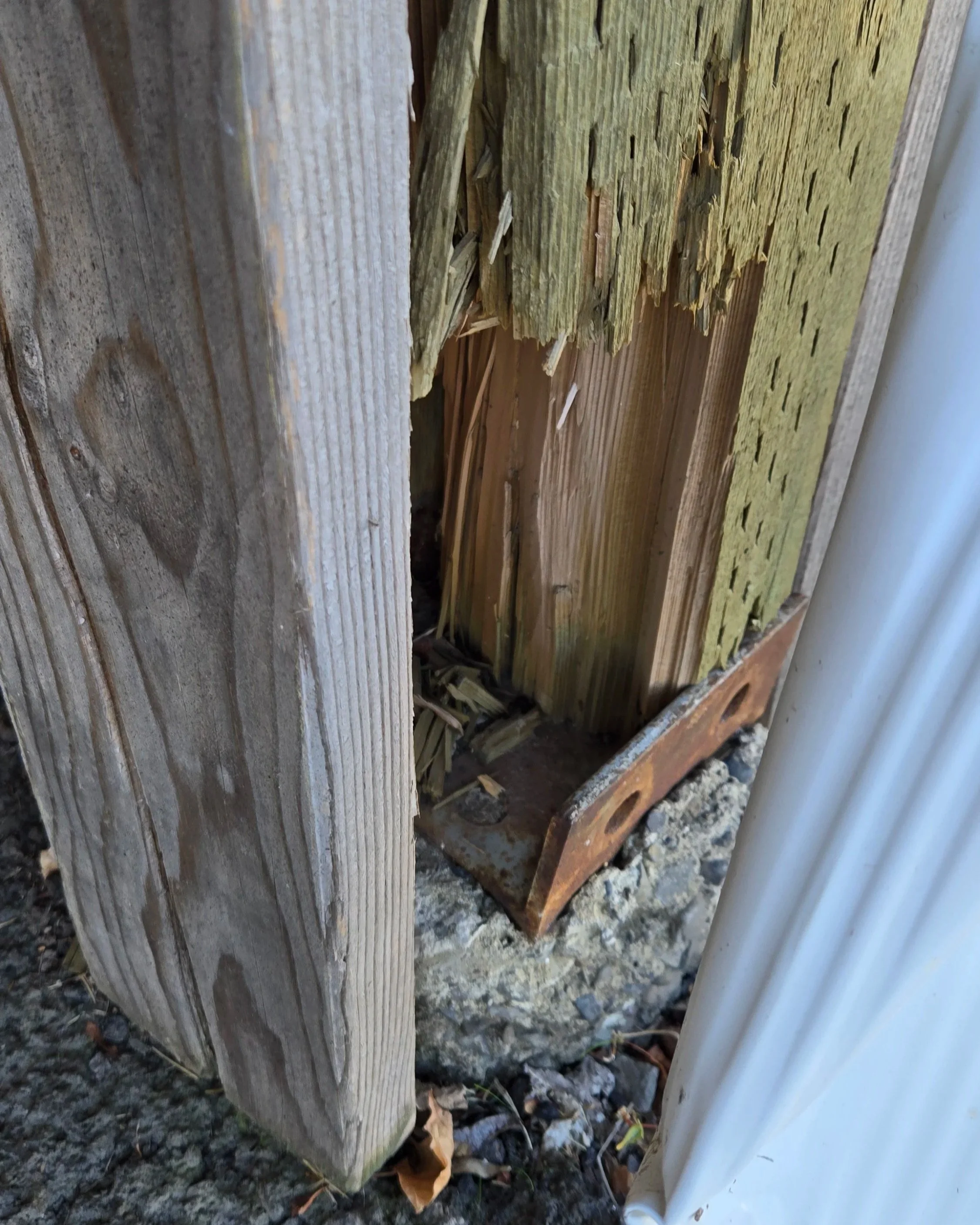
Impact Damage
The corner of the roof carrying the most wind uplift was the corner sitting two inches off its footing, held by columns no longer plumb. The impact hadn't just dinged a post. It had pulled the support out from under the load path at exactly the point where wind pushes hardest.
Repair to restore the support, before the next windstorm makes the decision for everybody.
The second structure told a different story — not impact, but age.
The older lumber rack cover used a pole-and-beam system, the original rear wall bearing its load down to a concrete foundation wall. That was the design. It was no longer the reality. A newer beam system had been installed at the rear to carry the load — which means the original wall had been failing, and someone had built around the failure rather than fixing it.
That is the nature of an aging facility. The old structure doesn't get torn out when the new one goes up. It gets propped, patched, and absorbed into the next thing — load quietly handed off from a failing member to a retrofit, with no record of why. Walk the yard and you see one cover. Read the load path and you see two systems, interlocked, the newer one carrying what the older one could no longer hold.
The retrofit may be sound. That is not the point. The point is that the original wall failed, the repair addressed the symptom, and nothing on site tells the next owner what caused it — or whether it is still moving.
Two structures, two failures, two different clocks.
The shed fails loud. Impact you can see — a column off its footing, a base crushed, plumb gone. It announces itself at eye level to anyone who looks. The trouble is that almost nobody does, and the open wall means wind is waiting to finish what a forklift started.
The rack cover fails quiet. Nothing crushed, nothing leaning — just a load rerouted around a wall that gave up, with no sign at eye level and no record of why. You cannot see it. You can only read it, by following the load down to where it actually lands.
That is the lumberyard in one inspection. The retail floor sells possibility. The yard behind it carries tons — on columns in a forklift lane, on walls older than the men working beside them. Customer, driver, yard worker — each sees a slice. The buyer is purchasing all of it, the seen and the unseen, the loud failure and the quiet one.
What a missed finding costs here is not a line item. It is a roof corner that comes down in the next windstorm, or a foundation wall still moving under a repair nobody can explain — discovered after closing, priced entirely against the new owner. Caught during due diligence, the same two findings are a repair scope, a negotiation, and a number that moves the right direction.
That is the difference between walking a lumberyard and reading one. It takes an inspector fluent on both sides of the fence — the retail building out front and the light-industrial structure behind it — because the risk lives in the seam where they meet, and most of it is over your head.
It never hurts to look up.