

The Defect Is the Cheap Part
Why Due Diligence on a Historic Commercial Building Costs More, and What the Standard Scope Leaves to the Buyer
Every commercial building carries deferred maintenance. Historic buildings are no exception. Yet they don’t pencil the way modern commercial does. The reason? There is another rulebook for historic buildings.
In a conventional building, due diligence runs a familiar sequence. Find the defect. Price the repair. Put the number in the reserve schedule. Carry it into the negotiation. The sequence works because the middle step is simple: a repair costs what a repair costs.
In a historic building, that middle step is where the deal actually lives. The same defect can carry two entirely different prices depending on a decision the buyer may not have made yet — and in some cases has not been told they are making. The finding is the easy part. What governs the fix is the number that moves the transaction.
The Standard Scope Is a Triage, Not a Test
Commercial property condition assessments are generally performed against ASTM E2018, the standard guide for what it calls a baseline property condition assessment. That word is in the title for a reason. The standard describes observation — not testing.
The guide describes a walk-through survey supported by document review and interviews. It is a framework for looking, researching, and reporting.
What it is not is a laboratory.
What it is is a menu with a base course and options.
And the standard is candid in a way most buyers never read. E2018 explicitly identifies conditions and activities that fall outside its scope — a list that exists precisely so parties to a transaction can consider whether to pursue them. The guide is clear that pursuing any of them is the user's decision, and that a property condition assessment conforms to the standard whether or not a single one is pursued.
Read that again from the buyer's side. The consultant performs the baseline and identifies what is on the menu. The buyer decides what to order.
A buyer who does not know the menu exists receives the baseline and calls it “the inspection.” That buyer has not been shortchanged — they have been served exactly what the standard describes. They simply made a purchasing decision without knowing they were making one.
Age Is a Referral Trigger, Not a Finding
This is where historic buildings diverge from ordinary ones, and the divergence is structural rather than a matter of degree. An older building's most consequential risks cluster disproportionately in the out-of-scope column.
An assessor walking a century-old building cannot see lead in the water. That is a laboratory result, and no amount of experience substitutes for one. What the assessor can see is original supply piping of an era and material that makes the question live — and that observation is worth more than a guess, because it converts a vague unease into a specific test with a specific price that fits inside the diligence window.
The pattern repeats across nearly every system in an old building.
| What the walk-through sees | What it cannot tell you | What it should trigger |
|---|---|---|
| Construction predating roughly 1980 | Whether pipe wrap, mastic, or floor tile actually contains asbestos | Asbestos survey with sampling |
| Finishes predating 1978 | Whether the paint is lead-based | Lead-based paint survey |
| Original galvanized or lead supply piping; pre-1986 solder | What is actually in the water | Water quality laboratory testing |
| Knob-and-tube; obsolete panel makes | Whether circuits are live, and whether the grounding path is intact | Licensed electrical evaluation |
| A breather pipe, a fill port, an oil-fired history | Whether a tank remains, and whether closure was documented | Phase I ESA under ASTM E1527; Phase II if warranted |
| Unreinforced masonry | Seismic adequacy | Structural engineer |
| Fire escapes serving as primary egress | Whether they will carry load | Certified load test |
| An elevator of significant vintage | Conveyance condition and code status | Licensed elevator inspection |
| A building predating 1990 | Accessibility exposure once alterations begin | Accessibility survey |
None of the items in the right-hand column is a failure of the walk-through. Every one of them is the walk-through succeeding. The assessment's highest-value output in an old building is not the defect list. It is the referral list — and the referral list is only useful if it arrives while the buyer can still act on it.
The Constraint Is What Actually Prices the Deal
Here is where most buyers of historic property worry about the wrong thing entirely.
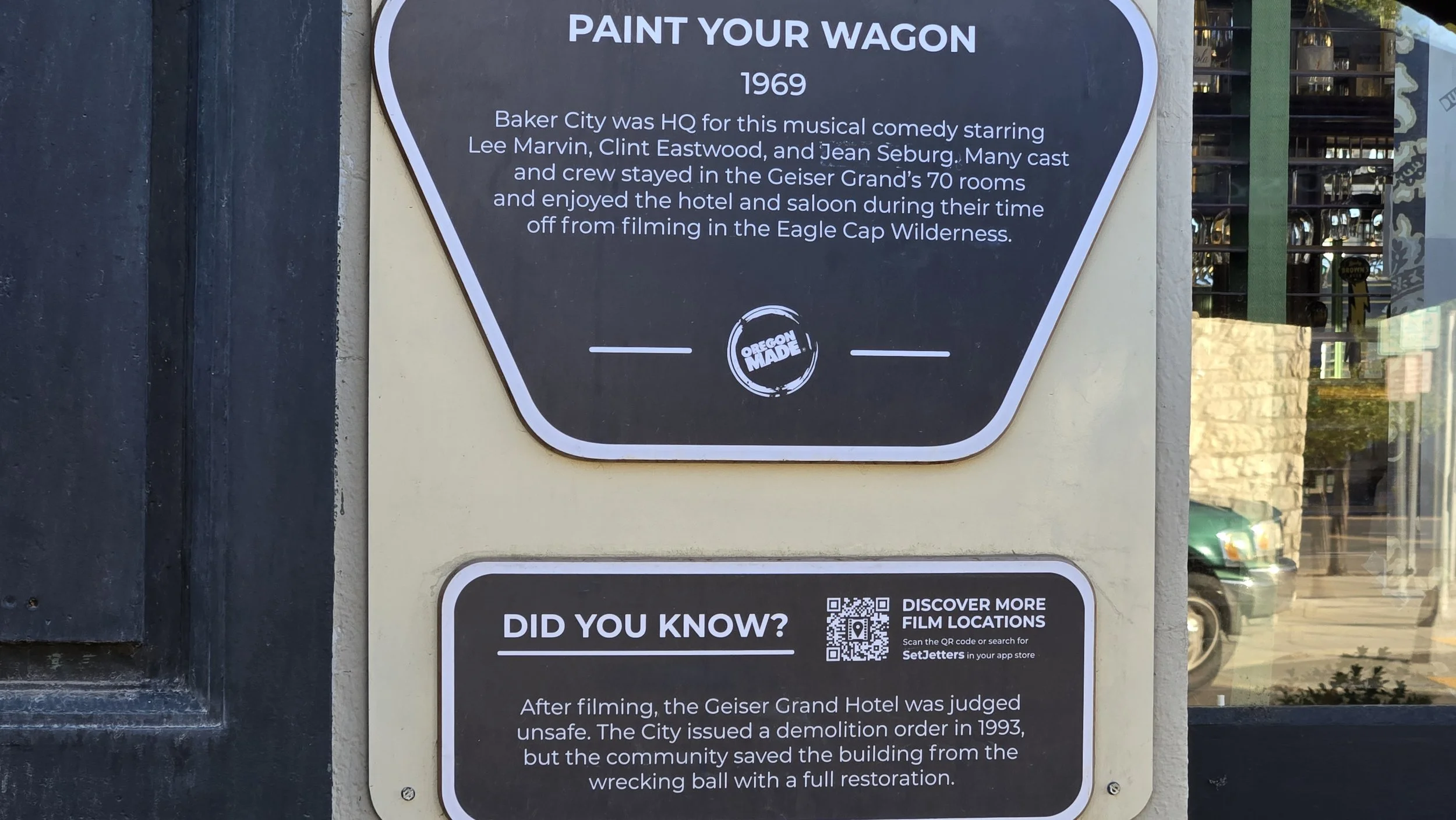
Plaque at Geiser Grand
Listing on the National Register of Historic Places imposes no federal restriction on what a private owner does with private money. None. A private owner may renovate, alter, or demolish a listed building without federal approval, provided no federal funding or permitting is involved. Idaho's State Historic Preservation Office states it about as plainly as a government agency states anything: the Register is largely honorific, and once a property is listed the owner is free to make alterations with private funds without prior approval from anyone.
The plaque is not the constraint. The constraint arrives from three other directions, and a buyer needs to know which ones apply before pricing a single repair.
The first is local. A municipal landmark ordinance or a locally designated historic district is where the genuine day-to-day authority lives — design review, certificates of appropriateness, and a commission with the power to say no to a window. This is entirely separate from federal listing, and it is the one most likely to govern ordinary work.
The second is federal involvement. Where federal funding or permitting touches a project, review obligations attach under the National Historic Preservation Act.
The third is the money, and it is the one that belongs in a reserve schedule. The federal rehabilitation tax credit returns 20 percent of qualified rehabilitation expenditures on a certified historic structure that is income-producing and depreciable. It is a genuine incentive and it does real work in a pro forma. It is also a contract. Accept the credit and the rehabilitation must satisfy the Secretary of the Interior's Standards for Rehabilitation, as determined by the National Park Service working with the state office, and the review covers the whole project rather than the parts an owner would prefer to submit.
Three mechanics of that credit deserve a line in any historic capital plan. Qualifying requires a substantial rehabilitation, measured against the building's adjusted basis rather than any figure the owner picks. The credit is claimed ratably across five years rather than all at once, which changes its timing value. And approval is not guaranteed by good intentions: replace an original feature without approval and certification can fail after the construction money is already spent.
| The constraint | When it applies | What it does to the project |
|---|---|---|
| Local designation — landmark ordinance or historic district | A municipality has designated the building or its district. Entirely separate from federal listing. | Design review, certificates of appropriateness, and a commission with authority over ordinary work — down to a single window. The one most likely to govern day-to-day. |
| Federal involvement | Federal funding or permitting touches the project. | Review obligations attach under the National Historic Preservation Act. |
| Federal rehabilitation tax credit (20%) | The owner accepts the credit on a certified historic structure that is income-producing and depreciable. | The whole rehabilitation must satisfy the Secretary of the Interior's Standards, as reviewed by the National Park Service with the state office. Certification can fail after the construction money is already spent. |
Stack those three and the consequence is unavoidable. A window that needs replacing costs one number in a building with no local designation and no credit in the pro forma. It costs a different number, on a different schedule, under review, in a building with either. Same window. Same rot. Different transaction.
Which is why historic due diligence has to run in a different order than ordinary due diligence. Find the defect. Determine what governs the repair. Then price it. Reversing the middle two steps produces a reserve schedule that looks rigorous and is fiction.
There is relief in the codes for exactly this problem — the existing building code carries provisions addressing historic structures, and federal accessibility requirements contemplate alternatives where strict compliance would threaten a building's historic character. These are real and they are useful. They are also conditional, and a buyer who assumes them without confirming them has substituted optimism for diligence.
Budget the Diligence, Not the Inspection
The practical guidance follows directly, and it is mostly about sequence and budget rather than effort.
Treat the inspection fee as the first line of a diligence budget rather than the whole of it. On a historic building, the assessment’s job is partly to tell a buyer which additional questions they now have to pay to answer. A buyer who has budgeted only for the walk-through has budgeted for the question and not the answer.
Walk the building first, then order the laboratory work. The sequence is not arbitrary. The walk-through is what tells a buyer which tests are worth buying, which is considerably cheaper than testing everything and infinitely cheaper than testing nothing.
Ask the consultant directly what fell outside the scope of the assessment. The standard obliges a consultant to work within a defined scope; it does not oblige a buyer to accept the baseline. That conversation takes ten minutes and is the single highest-leverage exchange in the entire diligence process.
Decide the tax credit question before diligence rather than after. Whether a buyer intends to pursue the credit determines what every subsequent repair costs, which regime reviews it, and how long it takes. A capital plan written before that decision is a draft.
And build the reserve schedule with a column most schedules omit. Not merely what is wrong, what it costs, and when it comes due — but what governs the repair. That column is where a historic building’s real capital exposure becomes visible.
What the Report Is Actually For
An ordinary building's assessment tells a buyer what is broken. A historic building's assessment tells a buyer what questions they have just inherited, what those questions cost to answer, and which authority will be reviewing the answers. The first is a report. The second is a plan.
The charm of an old building is genuinely worth paying for, and the buyers who do the best with these properties are usually the ones who wanted them for the right reasons. But the charm is priced into the ask. The systems behind it are priced into the reserves. And the rules governing what an owner is permitted to do about those systems are priced into neither, until someone does the work of finding out.
That work is available before the signatures or after. It costs the same to perform. It is worth wildly different amounts depending on when it happens.
Calibre Commercial Inspections reads historic commercial buildings system by system, and tells buyers plainly which questions the walk-through answered and which ones it just handed them.