

Concrete Cracks, Demographic Cracks
What Deferred Maintenance on America's Campuses Signals to College-Town Investors
I was attending a dance recital for a granddaughter, being held on a university nearby. As my daughters will attest, my eyeballs never stop moving, inspecting.
Occupational hazard.
On the way up to the on-campus theater, the cracks in these pictures caught my attention. The average person does not associate 1.5 inch cracks on fundamentals such as a stairway with the value proposition of a school of higher education.
But, the truth is, this is not an uncommon sight at most campuses, which is why I am not bothering to identify the institution. That kind of crack is not a failure of concrete. It is a failure of priority — and the priority equation on a college campus is becoming a problem worth thinking about.
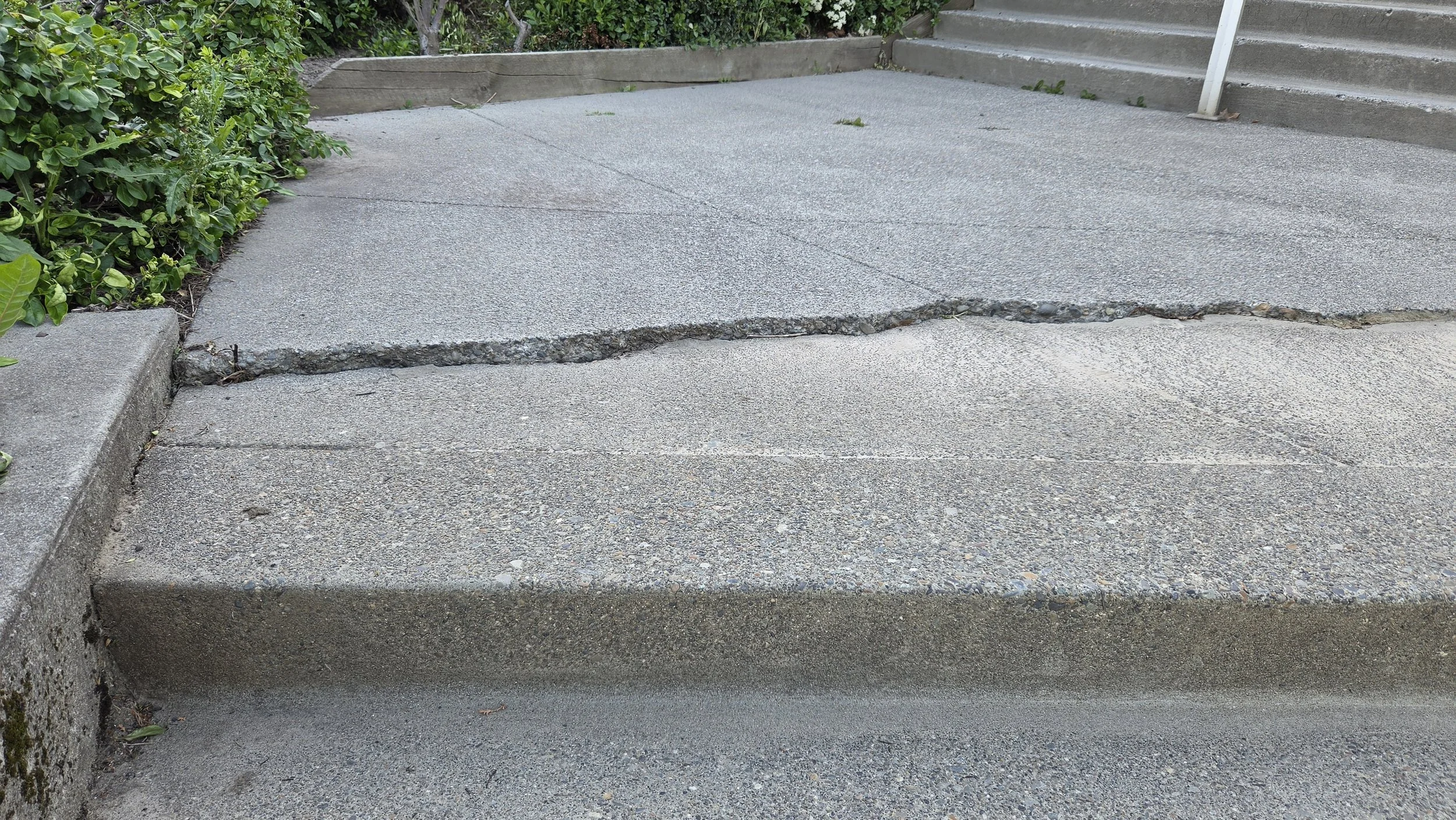
A trip hazard like this can cost an owner thousands in litigation alone.
Why Maintenance Loses the Fundraising Pitch
The structural reason for visible deferred maintenance on American campuses has nothing to do with concrete and everything to do with where the money flows. A new building or stadium is sexy. Many come with a donor name attached. Routine repairs are boring, the opposite of sexy. That asymmetry has shaped American higher education's capital priorities for decades, and the bill is now coming due.
Inside Higher Ed publishes an annual survey of college and university chief business officers — the administrators closest to the financial reality of running these institutions. In its most recent edition, more than a third of CBOs identified infrastructure and deferred maintenance as a top financial risk to their institution. Nearly two-thirds reported that their schools were funding up to a quarter of identified maintenance needs in the current fiscal year. At public doctoral universities, that figure rose to 89 percent. The pattern holds across institution types: public, private nonprofit, doctoral, regional, community.
The cause is structural rather than careless. State legislators tend to fund new capital projects over maintenance. Boards of trustees respond to donors who want their names on something visible. The internal accounting treatment of depreciation rewards growth and penalizes upkeep. A former college president recalled to Inside Higher Ed the dean of a private institution who shrugged off underfunding because, in his words, when major renewal was needed he would simply run a capital campaign to build a new building.
That is not a personal failing. That is the system telling its administrators which path of least resistance to take. The crack in the concrete is downstream from the incentive structure.
The Backlog Is Larger Than the Ribbon-Cuttings
Aggregated across the sector, the numbers are difficult to absorb. Moody's Ratings estimates that the roughly 500 colleges and universities it rates will need to spend somewhere between $750 billion and $950 billion over the next decade to address deferred maintenance, upgrade facilities, and complete the projects deemed strategically critical. That is just the rated institutions. The total higher education backlog runs higher still.
As the joke goes, "A billion here, a billion there, and soon we're talking about real money." Except that upper bound is approaching a TRILLION dollars.
Gordian, a construction cost data firm, publishes an annual State of Facilities in Higher Education report. Its most recent edition places the capital renewal backlog at more than $140 per gross square foot of campus space and documents renewal investment shortfalls exceeding 32 percent of what facilities actually require. These are not numbers any individual institution closes through a single campaign. They are accumulated structural debt to the buildings themselves.
F. King Alexander, who served as president of Louisiana State University from 2013 to 2020, described the dynamic in plain terms. During his tenure, deferred maintenance at the Baton Rouge campus grew by roughly $30 million per year. The university could cobble together only $8 to $10 million annually to address emergencies. The gap compounded. "We used a lot of duct tape," he said. Multiply that across hundreds of campuses, and the diagnosis from Seth Odell — founder of the education marketing firm Kanahoma — becomes harder to dismiss: deferred maintenance has become "part of a broader death spiral" many institutions have found themselves in.
The issue has migrated from a facilities concern into a strategic enrollment risk. Prospective students walk past shuttered buildings on campus tours. Admitted-student events run hot in halls whose HVAC has not been updated in decades. The perceived state of an institution feeds directly into yield — the percentage of admitted students who actually enroll — and yield drives revenue.
The Demographic Math Was Never Hypothetical
The reason this matters now, rather than in some indefinite future, is that the supply of students has begun to contract for the first time in a long time.
The mechanism is straightforward and was visible decades in advance. American birth rates fell sharply during the 2007 to 2009 recession and have not recovered, except for a brief post-pandemic blip. Eighteen years later, those missing births arrive on the high school graduation rolls. The Western Interstate Commission for Higher Education — which has tracked these projections for years — calculates that the number of 18-year-olds in the United States peaked in 2025 at roughly 3.9 million and will decline 13 percent by 2041. Several western states will see steeper declines on the order of 20 percent. Illinois, California, and New York are each projected to lose between 27 and 32 percent of their 18-year-old populations over that span.
Idaho is an outlier — and a positive one. The National Center for Education Statistics projects that Idaho high school enrollment will grow about 11 percent through 2031, the strongest projection in the country. A handful of southern and mountain west states show similar growth. Those states will not feel the cliff the way the rest of the country will.
But two additional factors complicate the picture in ways that matter for investors. The first is that the share of high school graduates going directly to college has been falling independent of how many graduates there are. The immediate college-going rate peaked at 70 percent in 2016. By 2022, it had fallen to 62 percent. Even where high school enrollment is growing, fewer of those graduates are enrolling in college.
The second factor does not get headline coverage. Women now make up roughly 57 percent of undergraduate enrollment nationwide. Men make up 43 percent. In 1970, the proportions were nearly reversed. The trend has accelerated over the last decade. Of the roughly 1.5 million students American higher education lost over a recent five-year window, men accounted for 71 percent of the decline. In 2022, 57 percent of male high school graduates enrolled in college the following fall, compared to 66 percent of female graduates. The male immediate-enrollment rate in 2022 was the same as it was in 1964. Meanwhile, men now make up about 90 percent of active registered apprentices, with participation growing in construction, manufacturing, and information technology trades.
The contraction in college demand is not only a baby-bust phenomenon. It is also a shift in how a significant share of young men weigh four-year degrees against shorter alternative credentials. Both effects compound.
What This Means for College-Town Multi-Family
Investors in college-town multi-family — purpose-built student housing or general apartment stock catering heavily to a university population — operate in a sub-segment whose demand floor was traditionally treated as durable. The university is always there. The students keep arriving. Underwriting models routinely assumed that institutional enrollment would hold flat or trend upward, and that the population pyramid feeding the institution would continue its long expansion. Neither assumption is safe anymore.
The investor in a college town inherits exposure through three channels.
The first is the source-market channel. Regional universities draw substantially from out-of-state students, often through compacts like the Western Undergraduate Exchange. Those source states — California, Oregon, Washington, Nevada, and beyond — are facing some of the steepest demographic declines in the country. An Idaho flagship that gains in-state enrollment may still see its out-of-state pipeline tighten, particularly when out-of-state tuition is a financial linchpin of its budget.
The second is the participation-rate channel. Even where the supply of 18-year-olds holds steady, college-going rates are softening. A university in a growth state can lose enrollment without losing population, simply because the share of high school graduates choosing college continues to decline. That softening is most visible at less-selective institutions and at regional public universities — the institutions most often surrounded by college-town multi-family.
The third is the institutional-health channel. An institution that has visibly let its physical plant decay is signaling something to its applicants and their parents. Yield drops. Enrollment thins. Multi-family demand softens. Visible deferred maintenance is not only an aesthetic concern — it is a leading indicator of competitive pressure that will surface in absorption numbers two and three years downstream.
For the investor, this argues for a few practical things. The institutional financial health of the host university is a portfolio risk worth tracking, not a peripheral consideration. Moody's and S&P bond rating reports, state higher education trust documents, and institution-level capital improvement plans relative to deferred maintenance disclosures all carry investment signal. Location within a college town's submarket matters more than it once did — student preference is increasingly tilted toward properties that compensate for what the campus itself does not provide. And the assumption of permanent demand is doing more work in pro formas than it should.
Cracks in Concrete, Cracks in the Funnel
The institution's deferred decisions become the investor's inherited assumptions. That is how this works. A university that has not been able to fund maintenance — because its incentive structure rewards capital expansion and donors prefer naming opportunities — is also a university whose enrollment math is becoming more difficult, whose applicant pool is contracting, and whose financial flexibility is narrowing. The same forces that produce visible decay on the property produce invisible compression in the financials.
The cracks in the concrete are easier to see than the cracks in the enrollment funnel. They show up the same way once you know what to look for.