
Welcome to the Hard Hat Zone!
Site safety coordination on an operating industrial property - what OSHA expects of a facility hosting outside personnel, what it costs when it goes wrong, and how it shapes what the inspection can actually cover.
When we show up on an industrial site, such as the former Pocatello Naval Ordnance Plant, we start the same way the facility would. Introductions first, safety briefing next.
Each facility builds a safety program. Our immediate task when we arrive is to find out how we can best comply. Generally, four questions need answers:
1. Do you need us in hard hats?
2. Do you need us in steel-toed shoes?
3. Do you need us in vests?
4. And, what is the facility policy for working around forklifts and other moving equipment?
Larger facilities have this dialed in - the process is nearly automatic.
I ask the same questions at smaller light industrial facilities, too. I am fairly sure we catch a lot of them off guard.
The questions surprised them because the inspector is usually the party being told what to wear, not the one asking. But an inspection on an operating industrial property is not a tour. It is an outside firm putting personnel on a floor where other people are working, near equipment they do not operate, under a safety program they did not write.
That arrangement carries obligations in both directions, and the facilities that have thought it through are, without exception, the ones that also have their maintenance records in order.
Now for the Un-Fun Stuff - OSHA
An inspector on an operating property is another contractor on your site. OSHA's multi-employer worksite policy holds that more than one employer can be responsible for a hazard on a single site. The employer whose people are exposed carries responsibility for them. The employer who controls the site carries responsibility for the conditions there, including conditions that outside personnel walk into. A property manager who lets a two-person inspection team onto an active warehouse floor without a word about traffic patterns has not transferred that risk by staying quiet about it.
The commercial consequences are more immediate than the regulatory ones. A recordable injury involving an outside firm still lands in the facility's incident history and its conversation with its insurer. For a tenant operating on a customer contract that audits safety performance, an incident involving a visitor is not a footnote. For an owner mid-transaction, an injury during due diligence is the kind of event that puts a hold on everything while counsel gets involved.
None of that is exotic risk. It is ordinary risk, and it is managed with a five-minute conversation before anyone walks the floor.
Why We Carry PPE
Personal protective equipment questions look like courtesy. They are actually a check on whether the facility has performed the hazard assessment that drives PPE selection. It also acts as a check on the inspection team - does our equipment match the hazard on that specific floor? It should, if we know our function.
Head protection under ANSI/ISEA Z89.1 comes in types and classes that are not interchangeable. Type I protects against impact to the top of the head. Type II adds lateral impact protection. We carry hard hats for Level II, plus Level II hats with chin straps for working at elevation. A hard hat that slips off when the ladder slides out provides zero protection. And, we’re not even going to get into the nitty-gritty of the electrical classes: My daughter is a power engineer - the requirements for substations are intense!
Protective footwear follows ASTM F2413, which covers impact and compression ratings along with optional metatarsal, puncture-resistant, and electrical hazard designations. High-visibility apparel - vests, in our case - follows ANSI/ISEA 107, where Class 2 and Class 3 garments differ in how much reflective and background material they carry, which matters in a yard, at a dock, or anywhere lighting is poor and equipment is moving.
How Not To Get Run Over By a Forklift
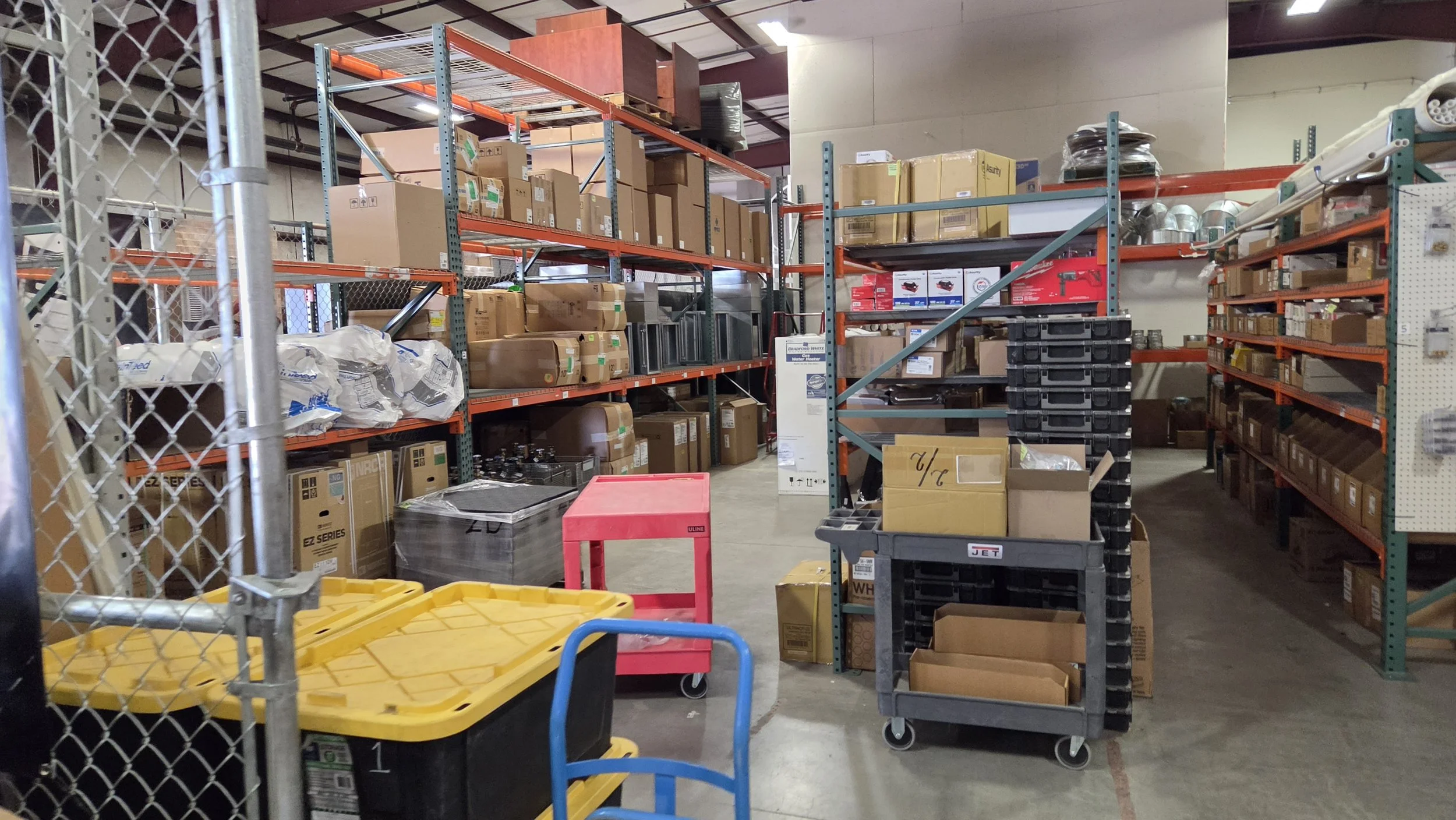
Powered industrial trucks are governed by 29 CFR 1910.178, which requires operator training, evaluation, and refresher training, and sets out operating rules that include pedestrian safety. Every substantial industrial property has a policy built on it. The problem is that the policy is written for people who work there.
A forklift operator moving product down a familiar aisle is looking for the pedestrians who know the rules and belong on that floor. An inspection team is a pair of people who do not belong on that floor, in unpredictable positions, stopping at electrical panels and column bases and roof drains, occasionally looking up rather than ahead. Add blind corners at rack ends, dock areas where trailers and lifts share space, and the ambient noise of an operating warehouse, and the exposure is obvious to everyone except the two people who just walked in.
The fix is procedural and cheap. Route the inspection around active operations where possible, notify operators on the floor, provide an escort in high-traffic areas, and agree in advance on what happens when the team needs to be somewhere a lift is working. Facilities with mature programs do this reflexively for any contractor. It should not require the visitor to ask.
Our team adds in a final rule, the most important one: be alert at all times. Sounds trite, it can be hard to do, but our safety and that of those around us, rely on it.
What Safety Conditions Bring an Inspection to a Halt
Some conditions are not negotiable regardless of the deadline.
Roof access. In general industry, fall protection is required at unprotected sides and edges 4 feet or more above a lower level. Inspectors work under slightly different rules for infrequent, temporary work. That said, we do not engage in risky behavior. If a roof cannot be safely accessed, we do not walk it. We have a drone and remote pilot certification for a reason. No project is worth a fall. ‘Nuff said.
Energized electrical equipment. NFPA 70E governs safe electrical work practices, including approach boundaries and arc flash PPE. A commercial inspection does not include energized work. Opening a deadfront on a large service is a decision that depends on qualification, equipment condition, and the facility's own electrical safety program. That is a decision that we made before arrival rather than in front of the panel. Our company policy (and industry Standards of Practice) dictate whether we open the panel. For anything larger than 225 amps, the answer is no, we do not.
Confined spaces and locked-out equipment. Pits, tanks, vaults, and similar spaces fall under 1910.146, and equipment under lockout per 1910.147 belongs to whoever placed the lock. Neither is inspector territory. Both come up more often on industrial property than owners expect.
Safety Limits Show Up in the Report as Limitations
This is where site safety stops being a courtesy issue and starts affecting the deliverable.
Neither ASTM E2018 nor the CCPIA Commercial Standards of Practice requires a consultant to access an unsafe area. Both are built around observation of areas that are readily accessible and safely observable, and both expect the report to say what could not be observed. That is honest reporting, but it is also a transfer of uncertainty. Every system that could not be reached becomes a limitation in the report, and every limitation is a question the buyer's lender, partner, or insurer may ask later.
A facility that cannot provide safe roof access on the scheduled day does not get a cheaper report. It gets a report with a roof section that says less. On an industrial asset where the roof and the electrical service carry most of the near-term capital, saying less is expensive.
What to Have Ready Before the Walk-Through
Facilities that make this easy tend to have the same short list ready:
• The site-specific safety orientation, and who delivers it
• PPE requirements by area, including whether Type II head protection is required
• Powered industrial truck traffic patterns and whether an escort is provided
• Roof access method, anchor points or perimeter protection, and who unlocks the hatch
• Electrical room access, and the facility's position on opening energized equipment
• Confined space locations and their status
• Tenant notification requirements and hours when access is permitted
• Certificates of insurance and workers' compensation coverage the facility wants on file
Sending that list with the inspection confirmation removes most of the friction. It also tells the inspector something useful about how the property is run before anyone sets foot on it.
Calibre Commercial Inspections performs commercial building inspections and property condition assessments on operating industrial, warehouse, and flex properties across Idaho, Eastern Oregon, Eastern Washington, and Western Montana. We arrive with our own protective equipment and we ask about your safety program before we schedule, because the inspection is not worth an incident on your floor. Contact us to discuss your property.