
Wildfire Pre-Inspections for Commercial Properties
Protecting Your Asset Before the First Spark
In 2024, Idaho recorded more than 1,400 wildfires that burned nearly one million acres — the highest total since 2012. The Idaho Department of Lands spent over $51 million on suppression efforts in a single season. And while much of the public conversation around wildfire focuses on residential homes and forested wilderness, commercial properties across the Intermountain West face a growing and often underestimated exposure.
For property managers and ownership groups with commercial assets in Idaho, the question is no longer whether wildfire will affect your portfolio. It is whether you will be prepared when it does.
A wildfire pre-inspection is one of the most effective steps you can take to protect your asset, strengthen your insurance position, and demonstrate compliance with local wildland-urban interface regulations — all before the first spark.
What Is a Wildfire Pre-Inspection — and Why Does It Matter?
A wildfire pre-inspection is a systematic, documented assessment of a commercial property’s vulnerability to wildfire. Unlike a standard property condition assessment (PCA), which evaluates general building systems and deferred maintenance, a wildfire pre-inspection focuses specifically on fire exposure, ignition pathways, defensible space, construction materials, vegetation management, and access for emergency response.
The purpose is twofold. First, the inspection identifies conditions that increase the property’s risk of damage in a wildfire event, giving property managers and owners an opportunity to address them proactively. Second, it creates a detailed, timestamped record of the property’s condition and any mitigation measures in place. That documentation becomes critically important if a loss event occurs, because it provides the baseline evidence needed to support an insurance claim and demonstrate that the property was being responsibly managed.
Without pre-loss documentation, property managers often find themselves in a difficult position after a fire: reconstructing what existed before the event, disputing adjuster findings, and absorbing costs that could have been recoverable. A wildfire pre-inspection eliminates that uncertainty.
Defensible Space: What It Means for Commercial Properties
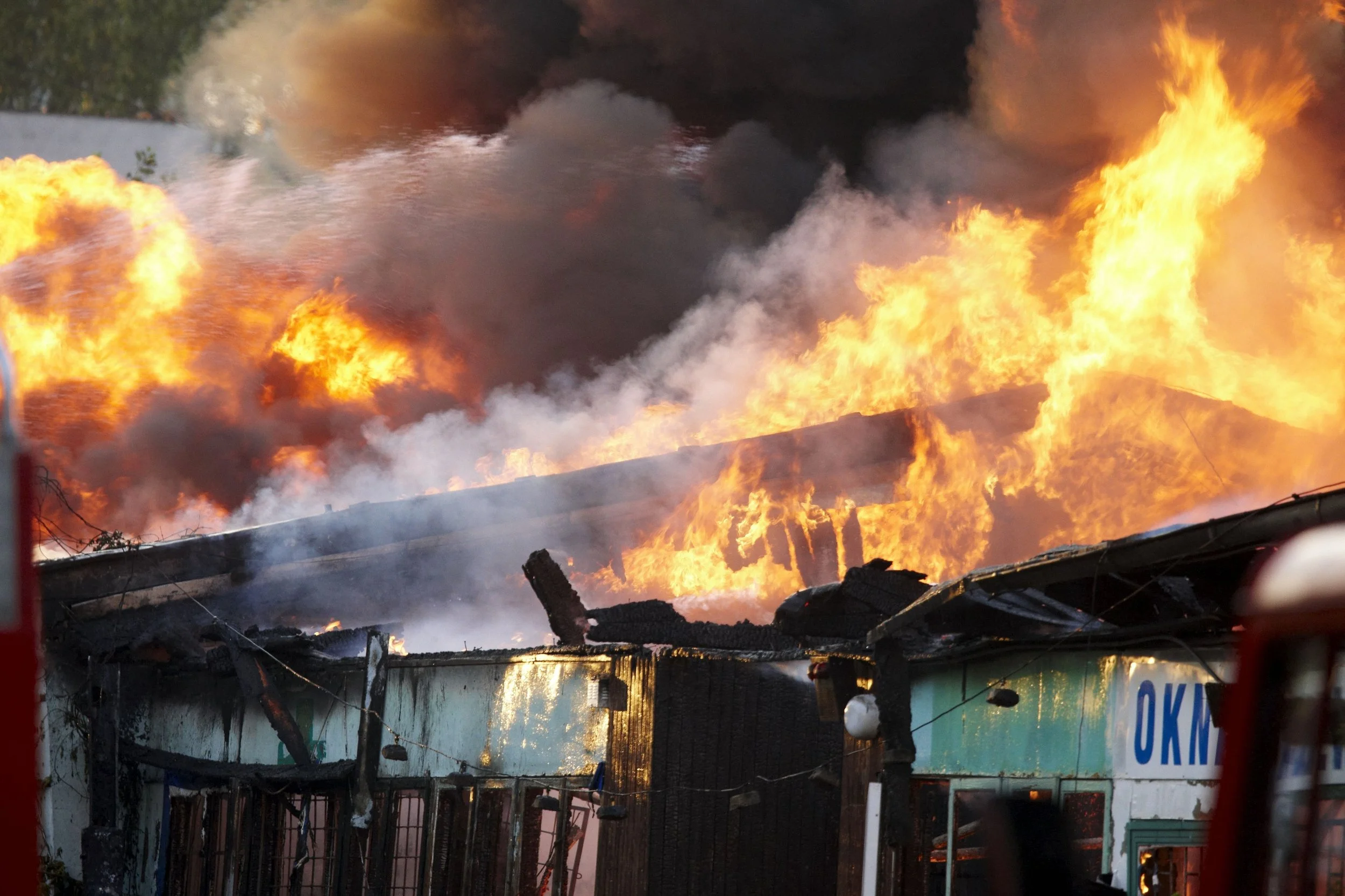
Defensible space is the buffer zone between a building and the surrounding vegetation, materials, and terrain that could carry fire toward the structure. The concept is well established in residential wildfire safety, but it applies equally — and in some respects more critically — to commercial properties, where building footprints are larger, occupant loads are higher, and the financial exposure from loss is substantially greater.
Defensible space is typically evaluated in concentric zones extending outward from the structure.
Zone 1 (0–5 feet from the structure) is the immediate zone. This area should be free of all combustible materials, including mulch, vegetation, stored goods, and debris. The ground surface within this zone should consist of noncombustible materials such as gravel, concrete, or pavers. This is the zone most frequently neglected on commercial properties, particularly around loading docks, waste enclosures, and mechanical equipment pads.
Zone 2 (5–30 feet) is the lean, clean, and green zone. Vegetation in this area should be well-maintained, low-growing, and spaced to prevent fire from carrying between plants or climbing into tree canopies. Dead vegetation, dry leaf litter, and accumulated organic debris should be removed. Trees should be limbed up a minimum of six feet from the ground to eliminate ladder fuels that allow fire to travel from the surface into the canopy.
Zone 3 (30–100 feet) is the reduced fuel zone. While more natural vegetation is acceptable here, spacing between trees, shrubs, and other plants must be sufficient to slow fire spread and reduce flame intensity as it approaches the structure. Dead trees, dense brush, and continuous ground cover should be thinned. On sloped terrain, the required distances may increase, as fire moves faster uphill.
For commercial properties, defensible space evaluation also extends to site features that are uncommon in residential assessments: perimeter fencing materials, parking lot landscaping islands, exterior signage, storage yards, propane or fuel storage, and utility infrastructure. A fence connecting a vegetation-laden perimeter to the building exterior, for example, can act as a direct ignition pathway that many property managers do not consider.
Regulatory Framework: WUI Ordinances in Ada County and Boise County
Property managers operating in the greater Boise area should be familiar with the wildland-urban interface (WUI) regulations that govern construction, maintenance, and land use in fire-prone zones. Both Ada County and Boise County have adopted specific WUI provisions, and compliance status is a key component of any wildfire pre-inspection.
Ada County has adopted the 2018 International Wildland-Urban Interface Code (IWUIC) with local amendments. Under Ada County Code Title 8, Article 3B — the Wildland-Urban Fire Interface Overlay District — properties within designated WUI areas must comply with standards covering defensible space, vegetation control, fire-resistive construction, emergency vehicle access, and water supply. Accessory structures within the defensible space perimeter must meet fire-resistive construction standards. Roads and driveways must maintain vegetation clearance, with all areas within five feet of each side of driveways cleared of combustible vegetation. The code also requires fire hazard severity assessments using the methodology from IWUIC Appendix C, and fire protection plans must be reviewed by the applicable fire district.
Boise County addresses wildfire risk through its Wildland-Urban Interface Ordinance (No. 2011-03), which was incorporated into the county’s Unified Land Use Ordinance. The ordinance governs development activity in WUI-designated areas and works in conjunction with the county’s building permit requirements and fire safety standards.
The City of Boise maintains its own WUI Overlay (Section 11-02-07.3.H of the Boise City Code) and has adopted Chapter 41 of the International Fire Code, establishing WUI risk zones (IR1, IR2, and others) with specific requirements for new construction, renovations, outdoor fire use, and vegetation management. The Fire Code Official has the authority to identify additional at-risk areas and adjust risk zone boundaries based on current conditions.
A wildfire pre-inspection documents the property’s current compliance status with applicable WUI regulations. If deficiencies exist, the inspection report provides a clear, prioritized roadmap for bringing the property into alignment — a valuable tool for both property managers planning capital improvements and ownership groups evaluating risk exposure.
Common Pitfalls Property Managers Overlook
Even diligent property managers can miss wildfire vulnerabilities that a trained inspector will identify. Based on common findings across commercial properties in the Intermountain West, these are among the most frequently overlooked conditions.
Combustible materials stored against exterior walls. Pallets, cardboard, recycling bins, and seasonal inventory stacked against the building exterior create direct ignition points. This is especially common at loading docks, back-of-house areas, and tenant storage zones that may not receive the same maintenance attention as the building’s primary frontage.
Unmaintained vegetation in parking lot islands and perimeter landscaping. Ornamental plantings installed at the time of development may have grown unchecked over time, creating dense, continuous fuel loads that were never part of the original landscape design. Dead or drought-stressed plantings are particularly hazardous.
Combustible fencing connecting to structures. Wood or vinyl fencing that runs from a property boundary or vegetation area directly to a building wall creates a wick effect, carrying fire to the structure even when the building materials themselves are fire-resistive.
Accumulation of debris in gutters, on rooftops, and around HVAC equipment. Leaf litter, pine needles, and organic debris that accumulate on flat commercial rooftops and around rooftop mechanical units are prime ember-catching materials. A single ember landing in a debris-clogged gutter or near an intake vent can ignite a building that otherwise appears well-maintained.
Inadequate clearance around propane tanks and fuel storage. Propane tanks and other fuel storage require a minimum of ten feet of clearance to bare mineral soil. On commercial properties, these installations are sometimes screened with combustible fencing or vegetation for aesthetic reasons, which negates the safety benefit.
Obstructed or poorly maintained fire access roads. Commercial properties in WUI zones must maintain access roads that allow emergency vehicles to reach the structure. Overgrown vegetation, locked gates without Knox Box access, and unpaved roads that degrade during weather events all compromise fire response.
Outdated or inadequate roofing materials. Older commercial buildings may have roofing assemblies that do not meet current fire-resistive standards. A wildfire pre-inspection evaluates roof covering, underlayment, and edge treatments for vulnerability to ember exposure and radiant heat.
The Insurance Connection: How Pre-Inspection Strengthens Your Position
The property and casualty insurance market has undergone a significant shift in how wildfire risk is evaluated and priced. Across the Intermountain West, carriers are tightening underwriting standards, requiring more detailed property assessments, and in some cases withdrawing from markets they deem too risky. As we discussed in our previous article, The Shifting Landscape of Property and Casualty Insurance: Risk Mitigation in a Changing Market, insurers are increasingly relying on third-party inspectors to verify property conditions and mitigation measures before issuing or renewing policies.
For property managers and ownership groups, this trend has direct implications. A wildfire pre-inspection provides exactly the kind of documentation that carriers are looking for: a professional, third-party assessment that details the property’s fire exposure, the condition of defensible space, the fire resistance of building materials and assemblies, and any mitigation measures in place. Having this documentation available at the time of policy renewal or application can influence coverage terms, premium calculations, and the likelihood of policy continuance.
In the event of a loss, pre-inspection documentation serves a different but equally important function. It establishes the property’s condition and value before the fire, which strengthens the foundation of any claim. It provides evidence of responsible property management and compliance efforts, which can counter adjuster arguments about negligence or deferred maintenance. And it creates a clear, contemporaneous record that reduces disputes about what existed, what was damaged, and what the property requires for restoration.
The cost of a wildfire pre-inspection is modest relative to the exposure it addresses. The cost of not having one — measured in claim denials, underpayments, coverage gaps, and lost asset value — can be significant.
Taking the First Step
Wildfire risk in the Intermountain West is not diminishing. Development continues to push into the wildland-urban interface. Fire seasons are growing longer and more intense. Insurance markets are tightening. For property managers and ownership groups responsible for commercial assets in Idaho, Washington, Eastern Oregon, and Western Montana, a wildfire pre-inspection is a practical, actionable measure that addresses all three of these realities simultaneously.
Understanding your property’s specific vulnerabilities, documenting its current condition, and establishing a clear record of compliance and mitigation is the foundation of responsible asset stewardship in a fire-prone landscape. The time to assess your exposure is before fire season — not after.
Calibre Commercial Inspections serves commercial property owners, managers, and investors across Idaho, Washington, Eastern Oregon, and Western Montana. Our team brings deep regional expertise and a thorough understanding of wildland-urban interface requirements to every assessment we perform.