

Why Even Solid Electrical Systems Fail the Test
Client Electrical Needs Define Commercial Due Diligence
Two recent jobs that we worked on, one in the Boise region and one in Spokane, illustrated from opposite directions how easy it is to misread the electrical service of a commercial building.
The first was a small office space a buyer intended to convert into a pizzeria. Sounds easy, but a commercial kitchen has very different needs than a small office space with three tenants. The conversion required either 400 amps of 120/240V single-phase or 200 amps of three-phase for the ovens, and the existing service was 300-amp single-phase — a shortfall that would have required a full service upgrade before a single oven could be energized.
The second was a Spokane property with a single tenant listed with 800 amps of 208Y/120V three-phase service to the building. Abundant capacity at first glance, but the service was distributed across 23 separate meters from the building's prior multi-tenant life. Each meter had a separate panel.
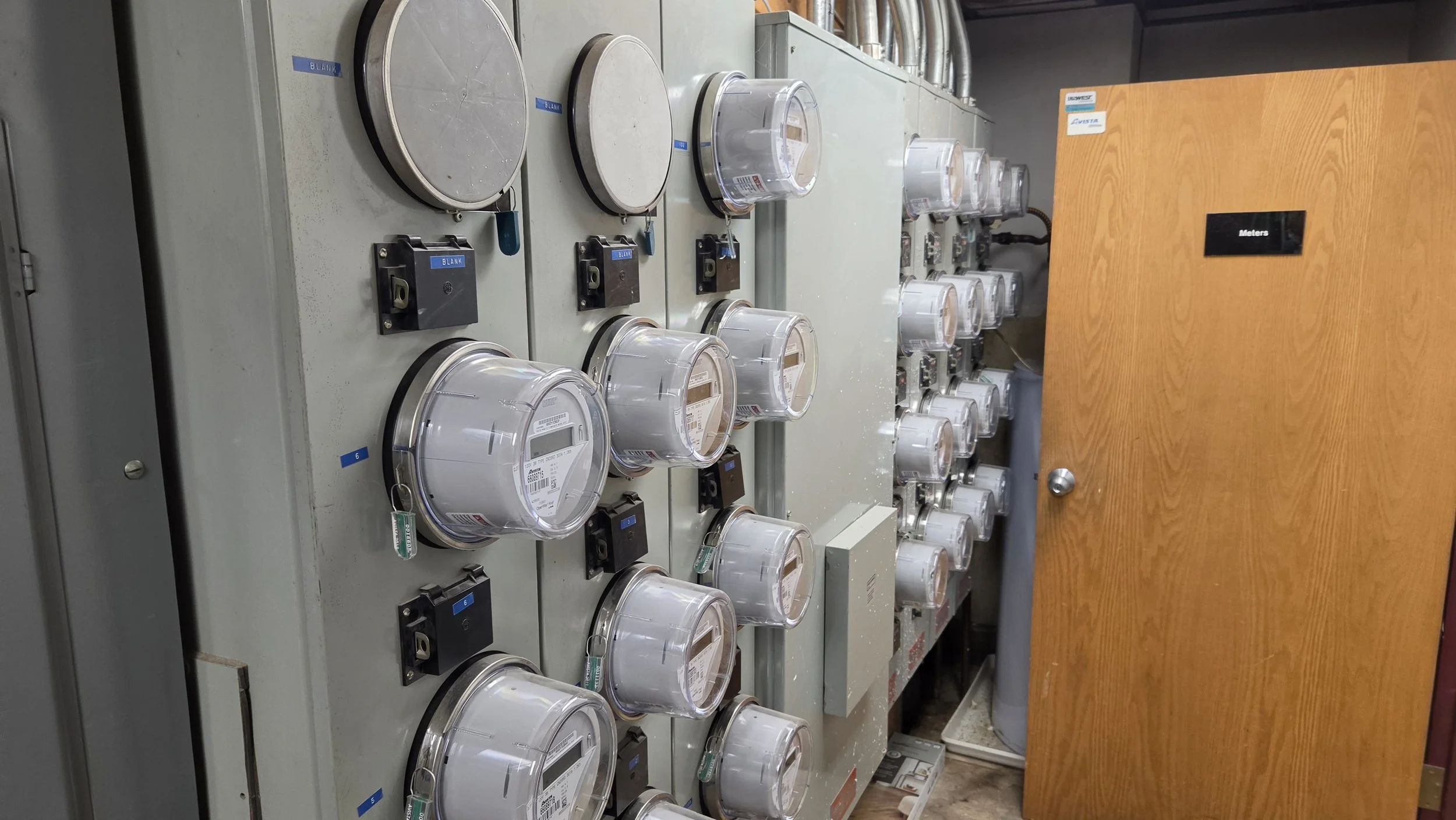
Multiple Meters Work for Multiple Tenants - But What If There’s Only One
Both buyers assumed the electrical service on their target building was "enough." Neither was necessarily wrong about the numbers until we look at their intended uses. Both were wrong about how the existing system could actually work against their plans.
Why Electrical Service Gets Overlooked in Commercial Due Diligence
Commercial electrical service is one of the most consequential line items in a property's infrastructure and one of the most frequently glossed in due diligence. Buyers often see an amperage figure on the meter or the main disconnect and assume the building is "wired" for whatever use they have in mind. The meter — or meters, plural, in many commercial buildings — tells only a small part of the story.
Three interlocking variables determine whether a commercial electrical service supports the client’s intended use: total capacity, phase configuration, and distribution architecture. Each one can quietly disqualify a building for a given purpose even when the others look adequate.
Service Capacity Sets the Ceiling on Demand
The ampacity of a service sets the ceiling on simultaneous electrical demand. While load calculations are outside the scope of a commercial inspection, NEC Article 220 governs how commercial load calculations are performed, and those calculations depend heavily on occupancy type. A 3,000-square-foot office might run comfortably on 200-amp single-phase service with room to spare. The same square footage operating as a full-service restaurant — commercial ovens, walk-in refrigeration, hood exhaust and makeup-air systems, dishwashing, HVAC — can easily demand four to six times the connected load of the office use it replaced.
Conversions from one occupancy use to another are where this mismatch becomes expensive. A buyer purchasing an office condo or retail bay to convert to food service is not buying the existing electrical load profile; they are buying whatever the service can carry. If the calculated load for the new use exceeds available ampacity, the options are narrow: upgrade the service (which involves the utility, the meter base, the service entrance conductors, and often the main panel), lease somewhere else, or scale the operation back to what the building will support.
Service upgrades start at four figures for smaller structures and climb to five figures and sometimes six, depending on whether new conduit has to be pulled, whether the serving transformer needs to be upsized, and how cooperative the serving utility proves to be on the timeline. None of that is a deal-killer in isolation. It becomes one when it surfaces after closing.
Phase Configuration Determines What Equipment Can Run
Commercial service configurations climb a ladder — from residential-style 120/240V adequate for offices and retail, through 208V and 480V three-phase for buildings with meaningful motor loads. The distinction matters more than many buyers realize:
120/240V single-phase. Residential and light-commercial. Adequate for small retail, offices, and businesses without significant motor loads. Practically maxes out around 400 to 600 amps before three-phase becomes the more economical choice.
208Y/120V three-phase (wye). The workhorse of small-to-midsize commercial buildings. Provides 120V for receptacles and lighting and 208V for three-phase equipment. Common in multi-tenant office, retail, and mixed-use construction.
480Y/277V three-phase. Heavier commercial and industrial service. Drives large motors, commercial HVAC, and industrial equipment efficiently. Typically stepped down through a transformer for convenience receptacles and general lighting.
Phase matters most for motor-driven equipment — commercial HVAC compressors, elevator drives, industrial kitchen equipment, machine tools, shop compressors. A three-phase motor runs more efficiently, starts under load better, and costs less to operate than a comparable single-phase unit. Some commercial equipment is simply unavailable in single-phase configurations at the sizes buyers need. A building wired for single-phase 400 amps cannot casually accommodate a three-phase 10-horsepower compressor no matter how much headroom the ampacity figure appears to offer. Converting single-phase to three-phase on an existing service is not a wiring adjustment — it is a new service.
Distribution Architecture Decides What's Actually Available
The third variable — how the service is distributed inside the building — is the one buyers miss most often. A building can have a large aggregate service and still offer very little usable capacity to a new tenant, because that service has been carved up for historical purposes that no longer apply.
Multi-tenant commercial buildings accumulate meters. Each time a tenant space was reconfigured, a new meter was frequently added rather than the existing architecture redesigned. Over decades, an 800-amp service can end up divided across 20 or more meters, each feeding a small panel with limited breaker positions and no practical path to expansion within its enclosure.
A buyer planning to occupy most or all of such a building as a single tenant faces a meter consolidation project: pulling sub-services back to a common point, sizing a new main distribution panel, coordinating with the utility on meter removal and re-read, and bringing the resulting configuration into NEC and local code compliance. This work is neither quick nor cheap, and it is routinely discovered only after closing, when the tenant build-out reveals that the panel available to the space has six spare breakers where 30 are needed.
What a Commercial Inspection Should Surface About Electrical Systems
A commercial inspection performed against the ASTM E2018 Standard for Property Condition Assessments or the CCPIA Commercial Standard of Practice should, at minimum, answer:
What is the service ampacity, voltage, and phase configuration?
How many meters are on the building, and what does each one feed?
What is the condition and remaining useful life of the main panel, sub-panels, and service entrance conductors?
Is there evidence of deferred maintenance — double-tapped breakers, mismatched components, signs of overheating, or legacy equipment such as Federal Pacific or Zinsco panels?
For a buyer with a specific use in mind — and most commercial buyers have one — the conversation with the inspector should start with a direct question: does the system have the capacity for my anticipated buildout? That question sits at the boundary between inspection and engineering, but a competent commercial inspector will be able to assist in defining the parameters and, if need be, refer the client to the appropriate specialist.
A buyer converting office space to food service does not need a general electrical assessment. They need a specific answer to a specific question: can this service, in its current capacity, phase, and distribution, carry what the new use will put on it? That is a different inquiry than "does the system meet code," and it is the inquiry that matters at the closing table.
What Buyers Should Do Before Writing an Offer
For any commercial property where the intended use will change or expand:
Define the intended use in detail — equipment list, estimated connected load, motor horsepower, and anticipated hours of operation.
Obtain existing service details from the utility or the meter socket, not only from the listing documents. Listing sheets are often wrong or incomplete about service size, voltage, and phase.
Communicate clearly with their commercial inspector prior to the inspection so the inspector evaluates the service against the intended use, not just against baseline standards for the current occupancy.
Consult the serving utility early if an upgrade appears likely. Lead times for commercial service changes in Idaho and Eastern Washington can run several months, particularly when transformer work or underground conduit is involved.
Budget realistically. An electrical service upgrade or meter consolidation is a capital project, not a punch-list item.
The Bottom Line
Two different owners can examine the same building and come away with radically different perceptions, all based on the intended use of the structure. Electrical capacity sits near the top of the list of items that separate a commercial building's nominal condition from its actual fitness for a given purpose. The rating on a system, or the voltage, is not a promise that all will be well; it is a starting point for a more specific conversation about phase, distribution, and intended use.
Calibre Commercial Inspections evaluates electrical service as part of every commercial property condition assessment across Idaho, Eastern Oregon, Eastern Washington, and Western Montana. As the region's only commercial-focused inspection firm, with decades of field experience, our team assesses electrical systems against the use a buyer actually has in mind — before closing, when the answer still matters. Contact us to discuss your property.