
The Stack Is Still Standing — A Montana Landmark
Structurally Sound for 108 Years, Economically Worthless for 46: What Anaconda's Big Stack Teaches Commercial Buyers About Masonry and Obsolescence
If you are a Lord of the Rings fan driving I-90 west of Butte, you might suspect that Saruman relocated his tower from Isengard to Anaconda, Montana. Visible from 20 miles away, a single dark shaft captures your attention as it gradually grows on the horizon. The closer you get, the more it dominates the landscape. Nothing stands around it and even the town of Anaconda remains hidden until the last few miles.
The resemblance runs deeper than the silhouette. Both towers outlasted the industry that raised them, and both stand on ground that industry ruined.
The first brick went into the Anaconda smelter stack on May 23, 1918. The last one went in on November 30 of the same year. Between those two dates, crews set 2,464,652 radial tile blocks — the volume equivalent of roughly 6.7 million ordinary bricks — into a chimney that reaches 585 feet overall, 555 feet of brick standing on a 30-foot concrete foundation. Smoke first passed through it on May 5, 1919.
As an aside, can you imagine any massive structure like The Stack getting built on that timeline? We’d never even clear the earliest regulatory hurdles, much less complete the project.
It has been standing for 108 years. For 46 of those years, it has done nothing at all.
Therein lies the tragedy, as this story does not have a wholly happy ending.
The stack is, by every available measure, a sound structure. It is also worth nothing as real property. Those two facts are not contradictory.
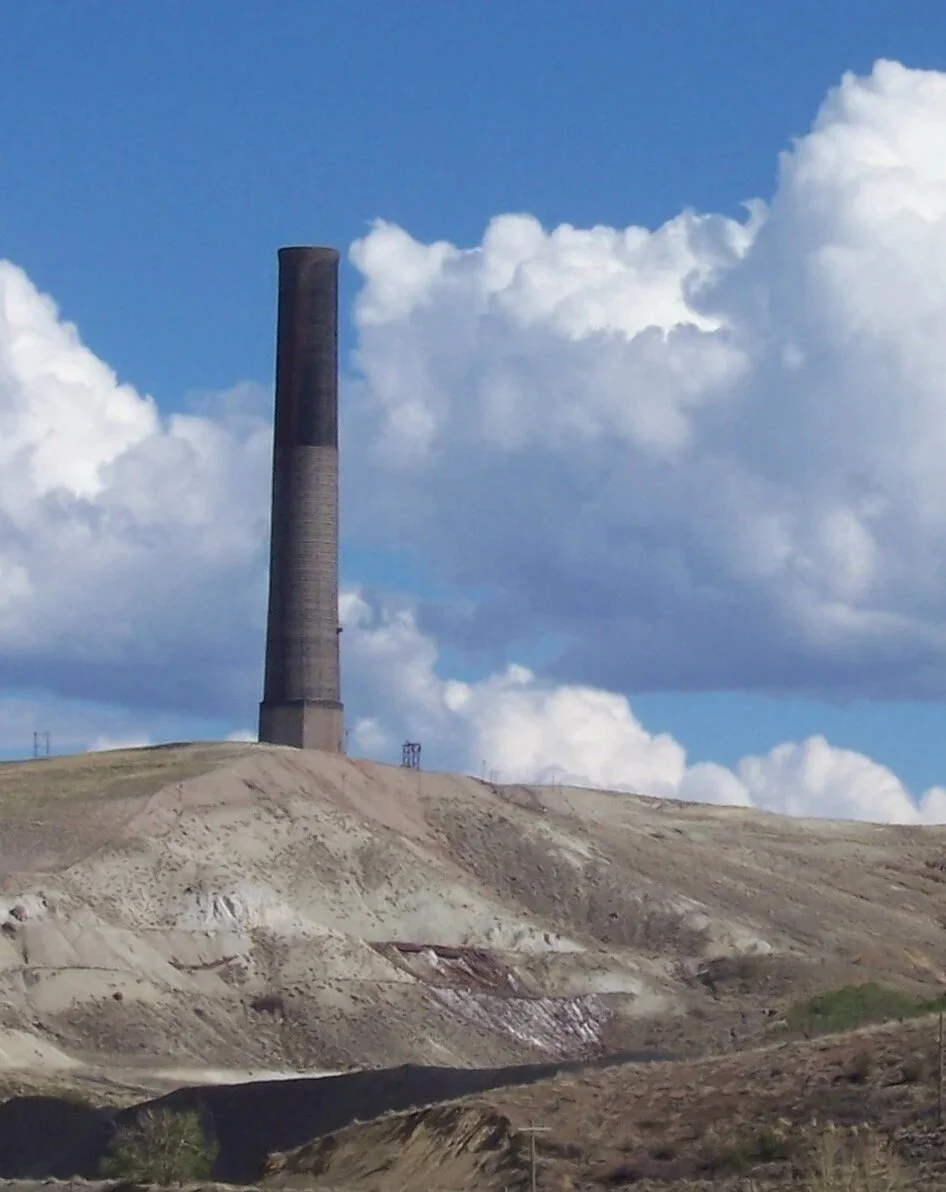
The Stack at Anaconda Towers Over the Horizon
The Chimney Was Built by People Who Understood What Kills Masonry
The Washoe Smelter's stack was designed and built by the Alphons Custodis Chimney Construction Company, a New York firm that did nothing but industrial chimneys. Its design decisions are still legible more than a century later, and none of them are decorative.
The walls taper from 5 feet 4 inches thick at the base to roughly 22 inches at the top. The interior diameter narrows from about 75 feet to 60 feet over the same run — wide enough that the Washington Monument would very nearly fit inside the shaft.
The lowest section is octagonal rather than round, its corners pointed at the compass directions and its flats turned to the wind. The circular shaft above is banded with steel reinforcing rods. Lightning protection went on at construction, not as an afterthought. The whole assembly was engineered to stand against a wind pressure of 33 pounds per square foot. In Montana, that is simply prudent.
The masonry units themselves were a decision too. Those 2.46 million blocks were perforated radial tile, each close to three times the volume of a common brick and curved to the shaft's radius.
Larger units mean fewer joints. Fewer joints mean less mortar exposed to weather, fewer paths for water into the assembly, and fewer places for the structure to come apart.
That is the core of the lesson. Masonry rarely fails at the masonry first. It fails at the joints, the terminations, and the places where water, wind, and freeze penetrates and stays, damaging the system one particle at a time.
So, What Happened . . .
Astoundingly, there is no serious argument that the structure is failing. It has outlasted the smelter it served, every other building on that hill, and the corporation that built it. The plant came down in 1981. The stack stayed up because a group of Anaconda residents organized to keep it. Montana named it a state monument in 1985, and it was listed on the National Register of Historic Places in 1987.
But . . . the unhappy ending.
It will also never again be worth anything as real property. Nobody will occupy it, lease it, insure it as an income asset, or underwrite a loan against it. Its economic life ended the day the smelter shut down in 1980.
The soil is contaminated. That’s why the park at the base of The Stack is closed, never to reopen. The soil across the site carries arsenic, cadmium, copper, lead, and zinc from decades of smelting. The entire surrounding area has been a Superfund site since 1983. You can admire the masonry, but only from a distance, a safe distance.
So, I detoured on my way home from an inspection in Helena to visit a commercial structure that intrigued me. In attention to geeking out from a safe distance, I learned a useful lesson.
Look deeper.
A sound building and a marketable building are not the same thing.
In commercial inspection terms, the physical structure can be fine, while underlying factors turn an asset into a contaminated clean-up project. There are not many clues, but we do have tools.
Phase I Environmental Site Assessments
If Property Condition Assessment performed to ASTM E2018 describes the structure and components, a Phase I Environmental Site Assessment works to identify certain, but not all, environmental hazards.
At its heart, the Phase I is a records and reconnaissance exercise. Yes, I do the physical inspection of the property searching for signs of contamination. I hand all that to the environmental engineers who do deep dives into the historical use of the property and the adjoining parcels, probe regulatory databases, and analyze the interviews. What it produces is an opinion on whether Recognized Environmental Conditions are present — the likely presence of a release of hazardous substances or petroleum products.
The reason to order one is not curiosity about the dirt. Under CERCLA, liability for contamination attaches to ownership, not to fault.
A Phase I conducted to E1527-21 satisfies EPA's All Appropriate Inquiries rule, and All Appropriate Inquiries is what qualifies a buyer for the landowner liability protections — innocent landowner, contiguous property owner, or bona fide prospective purchaser.
Skip it, and a buyer can acquire a cleanup obligation along with the deed. Anaconda is the monumental version of that arithmetic. The ordinary version is a dry cleaner that operated in the end unit until 1994.
Asbestos and Lead Are a Different Question Entirely
Contamination is about the ground. Asbestos and lead are about the building itself, and they are triggered by what a buyer intends to do rather than by what the seller did.
Asbestos comes first. The equivalent of the EPA All Appropriate Inquiries rule for asbestos is the Good Faith Survey or similar document depending on the State. The rules are pretty explicit. The NESHAP at 40 CFR Part 61, Subpart M regulates any demolition or renovation at an institutional, commercial, or industrial building, and at minimum it requires a thorough inspection for asbestos-containing material before work begins.
That’s a mouthful, but means that building owners have a duty to determine the presence, location, and quantity of asbestos-containing and presumed asbestos-containing material, and to pass that information to the contractors whose people will be working in it. A buyer planning a tenant improvement on a 1974 building has an inspection requirement whether they budgeted for one or not.
Lead-based paint is triggered less often on commercial assets, but not never. OSHA's lead in construction standard at 29 CFR 1926.62 governs worker exposure on any structure, and the disclosure and Renovation, Repair and Painting requirements reach residential and child-occupied facilities — which puts multifamily, daycare, and some mixed-use squarely in the sights.
Beyond those, the usual suspects: underground storage tanks, PCBs in older light ballasts and transformers, mercury in thermostats and lamps, and radon, which matters more in this region than in most of the country.
Calibre performs the physical assessment and coordinates the Phase I. The specialty work — asbestos and lead surveys, Phase II sampling — goes to the appropriate specialist, and we would rather tell a client which of those a deal actually needs than sell them a stack of reports it doesn't.
The building tells you what it costs to own. The record tells you what it costs to be the owner.