

Case Study: When a Small Pump Becomes a Big Problem
Sump Pump Failures and Their Impact on Commercial Properties
Overview
In commercial properties, water management systems rarely receive attention until they fail—if attention is paid at all. Whether it is stormwater drainage across the lot, roof drainage via scuppers or gutters, or intrusion issues, until something inside gets wet, nobody cares.
So, add the lowly sump pump to the list. While often perceived as a minor mechanical accessory, sump pumps play an outsized role in protecting foundations, slabs, structural components, electrical systems, and tenant improvements.
They are also frequently installed incorrectly.
This case study examines a real-world commercial inspection I performed where a failed sump pump system resulted in significant operational risk, deferred maintenance exposure, and unexpected capital expenditures. The property was located in an area with a known high-water table.
Property Background
Asset Type: Retail/Office
Construction: 1930s masonry
Location: Idaho
Below-Grade Components: Partial basement and crawlspace
Observed Conditions
During the inspection of the basement, standing water up to three inches deep was observed along the perimeter wall and floor slab of the basement. There was a foot of standing water beside the foundation wall in the crawlspace and the soil that the foundation bore to was eroding.
As I joked to the client, this building was not suitable for an indoor pool, yet here we were. Just for the record, prolonged moisture exposure at the slab and foundation walls increases the risk of foundation deterioration, mold development, and corrosion of mechanical and electrical components.
The sump pit contained a new pump, but it wasn’t plugged into the power supply. Also, the pump was a type used for the removal of water during flood events or draining events (think emptying a pool). There was no float to trigger automatic operation. That was our first fail.
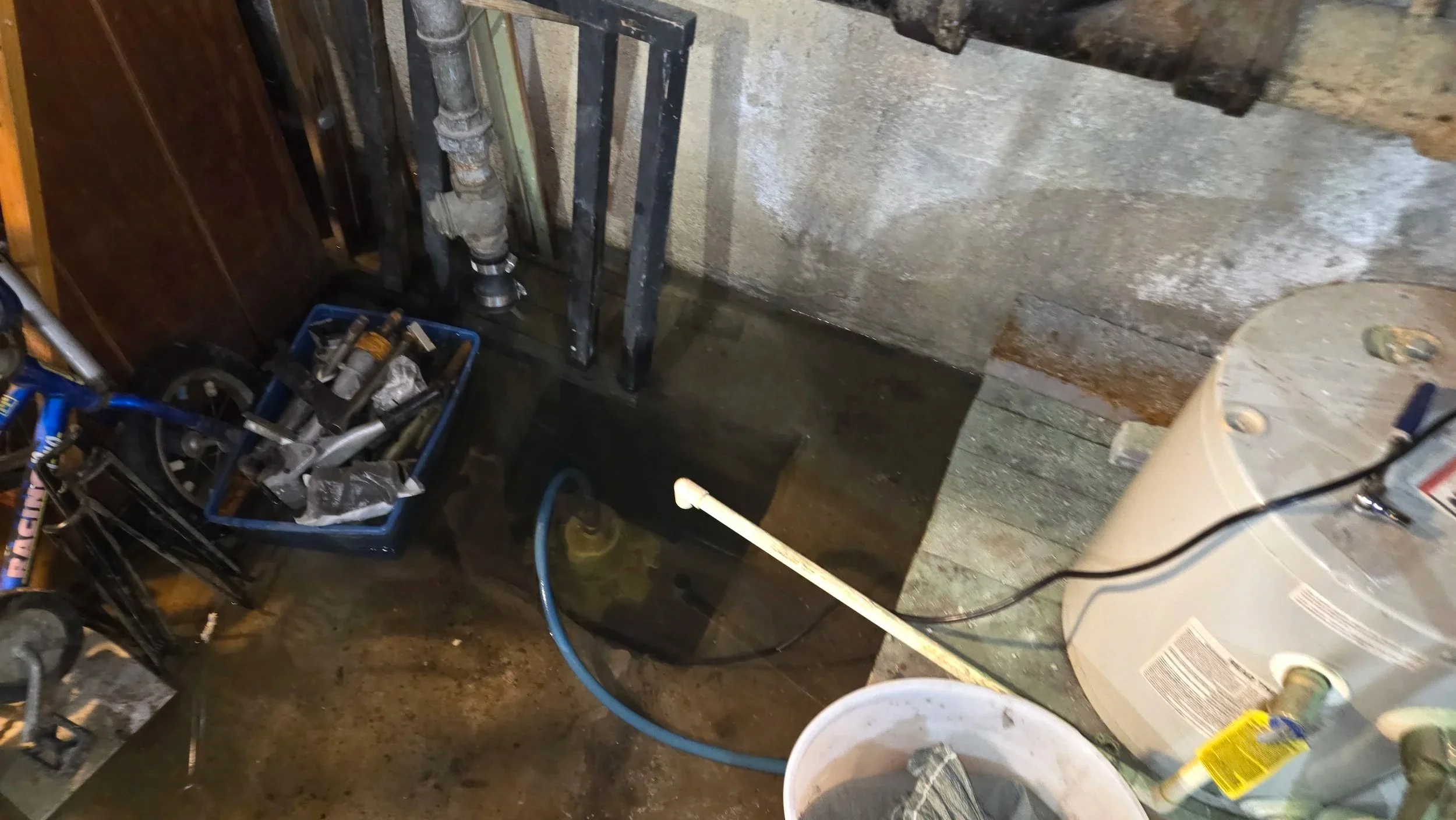
Submerged Sump Pump
The fact that I could directly observe the pump takes us to our second fail: no cover over the top of the sump, as required by plumbing code. This allows foreign objects and debris to enter the pit, which can block the float arm (if one were present) from activating the pump. It’s also a trip/fall hazard, per OSHA.
Item three—when the water began to flood the space, an alarm would notify us of the problem. In the absence of alarms, pump failures may go undetected until flooding occurs, increasing the risk of equipment damage and business interruption. Alarms are not expensive, especially in comparison to the damage that unidentified water intrusion can cause.
Now, let’s go to the picture and look at the discharge piping for the sump pump. It’s a garden hose—the sort that my grandfather would run for his sump pump. It was not a proper installation in 1952, and it is not a proper installation today.
The garden hose should have been a material that was capable of withstanding pressurized flows and resisting corrosion. The default is Schedule 40 PVC. Also, a check valve should have been installed so that water could not backflow to the sump. I have seen installations where the water gets pumped up to ground level and then flows right back down into the sump, leading to constant on/off cycling of the pump.
Onto the electrical connections. This sump pump was unplugged when I arrived. The plug was draped across the water heater. The other end of an extension cord was also draped there. So, to plug in the pump, you had to be standing in three inches of water. This is akin to tossing a toaster into a bathtub.
There should have been permanent wiring suitable for wet locations. The wiring should have been enclosed in conduit, and a GFCI breaker installed on the circuit.
Risk Implications
While the immediate repair cost of a sump pump is relatively modest, the downstream risks were significant, including foundation exposure, mechanical and electrical damage potential, business interruption risk, and insurance and lending complications.
Mold growth, as might reasonably be expected, was present.
Cost-to-Cure Considerations
Recommended repairs included replacement of the primary sump pump with a commercial-grade unit, installation of a backup pump, addition of a high-water alarm, cleaning and reconditioning of the sump pit, and correction of discharge piping and electrical connections.
Conclusion
Sump pumps rarely make headlines in commercial real estate transactions, but their failure can quietly undermine an otherwise solid asset. In commercial properties, due diligence is about understanding systems, anticipating failure, and protecting capital.